Episode 2: The map has grown a new finger since yesterday
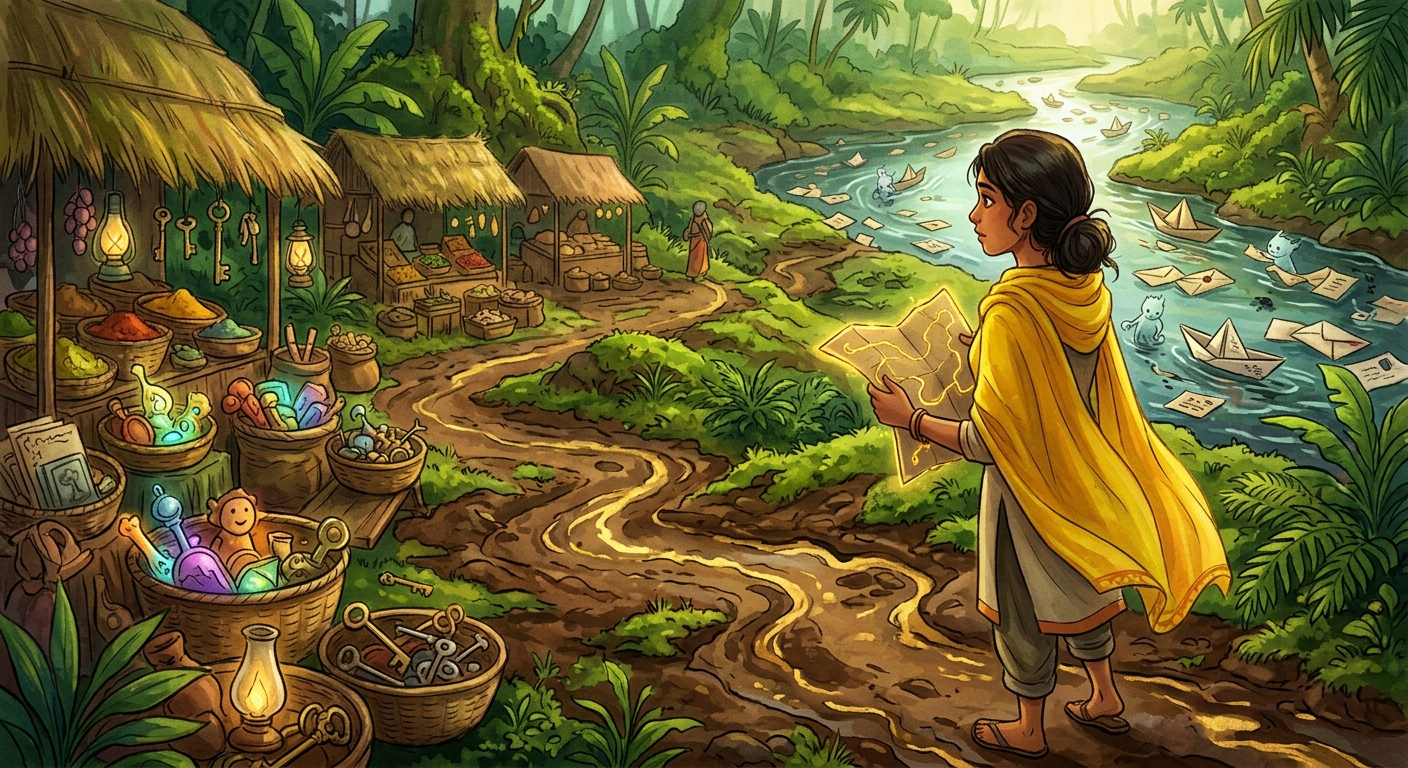
The map has grown a new finger since yesterday. A gold line, thin as a cat's whisker, branches off the fourth road and points directly at the center of the crossroads, at the stone where a girl who is not a girl is pouring chai from a kettle that steams without heat.
The chai tastes like my grandmother's kitchen. Cardamom. Too much sugar. The specific burn of a clay stove that Ammachi insisted on using even when my father bought her a gas connection. The taste hits the back of my throat and my eyes water, which is stupid, which is a chemical reaction to capsaicin and memory and nothing more.
I hold the cup with both hands because my hands are shaking and I do not want Kavitha to see.
She sees.
"They say the chai tastes different for everyone," she says, and her voice is the sound of rain on a tin roof, the specific rhythm of monsoon hitting the corrugated sheet above Ammachi's back veranda. "What does it taste like to you, moné?"
"Like a trick," I say.
She laughs. The laugh is old, older than the banyan tree at the turnoff, older than the road, older than the crossroads themselves. She is sixteen and she has been sixteen since before the stone she sits on was a stone.
The map is open on the ground between us. The gold ink catches light that comes from somewhere other than the sun — a light that is the color of temple lamps at dusk, the color of the oil Ammachi used to light in the puja room. The fourth branch, the one that was a solid line when I left the house this morning, is now a dotted line. A question mark. A path that flickers between existing and not existing, like a candle flame in a draft.
A new margin note has appeared. Ammachi's handwriting. Cramped. Precise. The Malayalam letters curling like the smoke from the chai Kavitha pours.
*Moné, the fourth road is not a road. It is a conversation. Walk it and you will understand.*
The ink is still wet.
I touch it with my thumb and the gold comes away on my skin, warm, alive. I wipe it on my jeans and it does not come off.
"You should not do that," Kavitha says. She is not looking at me. She is looking at the four roads, the four branches that meet at this impossible junction. "The ink remembers where it has been."
"The ink is ink," I say. "It is pigment and solvent. It does not remember anything."
"Your grandmother drew this map in 1971," she says, as if she knows this, as if she was there. "On the back of a ration card. The gold ink was from a pen she bought at a shop in Thrissur that has been closed for forty years. The pen cost three rupees and she bargained for it because three rupees was too much for a pen."
I do not ask how she knows this. I do not ask because asking would mean admitting that this place is real, that this girl is real, that the roads are real, and I am not ready to admit any of those things. I am here because Ammachi's map told me to come. I am here because the electricity bill is due and my father is drinking again and the house is empty in the specific way a house is empty when the person who made it a home is gone. I am here because I am angry and the anger needs somewhere to go and the road was the only direction that made sense.
"Four roads," Kavitha says. She sets down the kettle. The stone beneath her is too smooth to be natural, too old to be a chair. She has been sitting on it for longer than the stone has existed. "You know their names?"
"I don't care about their names."
"The first road is for the living." She points to the left, where the path is paved with red laterite, the kind that stains your slippers, the kind that turns to mud in the monsoon. "It goes to the places you have been. School. The chai stall near the bus stand. The house where your father is sleeping right now with the empty bottle on the floor."
I flinch. She does not notice or she does not care.
"The second road is for the dead." She points to the right, where the path is made of white ash, the kind that comes from the cremation ground, the kind that Ammachi's body became three months ago. "It goes to the places they have gone. I do not walk that road. I have never walked that road."
"The third road is for the spirits." She points straight ahead, where the path is made of something that is not light and is not dark and is not anything I have a word for. "It goes to the places that exist between. The yakshi in the banyan tree. The theyyam dancer who forgot to stop dancing. The ghost of the train that derailed in 1956 and still runs on tracks that are not there."
"You are making this up."
"I am telling you their names," she says. "Names are important. You cannot walk a road you refuse to name."
"And the fourth?" I ask, because I have to, because the map is glowing and the margin note is wet and the dotted line is flickering and my grandmother's handwriting is pointing me toward it.
Kavitha does not point. She looks at me. Her eyes are the color of monsoon clouds, the specific grey that means it will rain for days, that the rivers will rise, that the frogs will sing all night.
"The fourth road changes," she says.
"That is not a name."
"It is the only name it has."
I look at the map. The fourth branch is a dotted line that becomes a solid line that becomes a question mark that becomes a spiral that becomes a word in Malayalam that I cannot read because it is written in a hand that is my grandmother's and is also my own.
[medium pause]
"You are going to walk it," Kavitha says. It is not a question.
"I am going home," I say. "I am going to pay the electricity bill and make my father eat something and go to school tomorrow and pretend that this" — I gesture at the roads, the crossroads, the girl, the map, the chai that tastes like grief — "did not happen."
"You can do that," she says. "Many do. Most, in fact. They come to the crossroads and they drink the chai and they go home and they pretend. The living road is full of people pretending."
"I am not pretending. I am being practical."
"You are being afraid," she says, and her voice is gentle in a way that makes me want to throw the chai cup at the ground and watch it shatter. "Fear is practical. Fear kept your ancestors alive through the monsoons and the famines and the colonizers and the partition and the wars and the floods. Fear is a good thing, moné. Fear is a name for love that has lost its way."
"I am not afraid."
"You are shaking."
I look at my hands. They are shaking. The chai is sloshing in the cup, tiny waves, a monsoon in miniature.
"It is the cold," I say.
"It is thirty-four degrees," she says. "The humidity is ninety-two percent. You are sweating through your shirt. The only cold here is the cold you brought with you."
I set down the cup. The stone is warm beneath my fingers, the specific warmth of a place that has been in the sun for a thousand years, that has seen a thousand monsoons, that has held a thousand travelers who came to this crossroads and had to choose.
"Walk the fourth road," Kavitha says. She is pouring more chai. The kettle is always full. The steam is always rising. "Walk it and you will understand what your grandmother was trying to tell you."
"She is dead," I say, and the word is a stone I throw at the ground, at the map, at the girl, at the roads. "She is dead and she is not trying to tell me anything because dead people do not talk."
Kavitha looks at me. She does not blink. She has not blinked since I arrived.
"The map is talking," she says. "The ink is talking. The road is talking. Your grandmother is talking, moné. The question is whether you are ready to listen."
I look at my Nokia. No signal. The screen shows the time — 4:47 PM. The battery is at sixty-two percent. The phone is a rectangle of plastic and circuitry and it knows nothing about roads that change or girls who are sixteen forever or grandmothers who draw maps on ration cards. It is a phone. It makes calls. It sends texts. It has no signal because there is no signal in a place that does not exist.
I check it again. Still no signal.
"She is still walking it, you know," Kavitha says, and her voice is different now, softer, the rain on the tin roof becoming a drizzle, a mist, a whisper. "The fourth road. Your grandmother. She is still walking."
I look up. The map is glowing. The margin note is in Ammachi's handwriting, but the ink is fresh — fresher than the paper, fresher than the funeral, fresher than anything that should be possible.
*Moné, I am still here. Walk and find me.*
The fourth road is a dotted line that becomes a solid line that becomes a question mark that becomes a spiral that becomes a word in Malayalam that I can read now, that I can see now, that says: *Come.*
I pick up the map. The gold ink is warm on my fingers. The chai is cooling in the cup. The four roads are waiting.
Kavitha does not smile. She pours the chai. The steam rises.
"The monsoon comes early on the fourth road," she says. "The mud will be the color of your grandmother's hair. Walk carefully, moné. The road remembers everyone who has ever walked it. It will remember you."
I fold the map. I put it in my pocket, next to the electricity bill. I pick up my bag. I look at the four roads — the red laterite, the white ash, the something that is not light, the dotted line that flickers.
I take a step toward the fourth road.
The ground shifts beneath my feet.
The map glows.
The chai cup is empty.
The road is waiting.
The map is a conversation. It does not give you directions; it gives you questions. It does not tell you where to go; it asks you where you want to be. The fourth road is the one that changes because it is the one that requires you to carry a map that talks back, to walk with a guide that is also a partner, to move through a world that responds to your presence.
We have been building a map like that. A system that does not just deliver content but responds to it. A framework that does not just display information but converses with it. A road that changes as you walk it, that remembers your footsteps, that grows new branches when you ask new questions.
The crossroads is the deployment point — the moment where the architecture reveals itself. The four roads are four states, four streams, four possible paths. Kavitha is the threshold, the point of entry, the server that serves chai and answers. The map is the interface, the conversation log, the margin notes that appear when you need them.
Arjun is the new user, untrained, angry, inheriting a system he did not build. He does not know the rules. He does not trust the map. He is walking anyway.
This is how we build. Not with instructions, but with invitations. Not with manuals, but with margin notes. Not with roads that are fixed, but with roads that change.
[long pause]
The map has grown new fingers since last we spoke. Paths that did not exist are now dotted lines, question marks, spirals that lead somewhere. The gold ink is fresh. The margin notes are addressed to you by name.
What shipped this cycle is a conversation. A system that does not just deliver but responds. A framework that does not just display but asks. The map is open on the ground between us. The ink is still wet. You can read the margin notes now — they are in your language, in your voice, in the specific cadence of the way you think.
The four roads are named. The first is for the living — the content you already know, the paths you have already walked, the familiar red laterite of your daily work. The second is for the dead — the archives, the history, the white ash of what came before. The third is for the spirits — the integrations, the connections, the something that is between the things you can see. The fourth is the one that changes. The fourth is the one that requires you to carry a map that talks back.
The chai is poured. The stone is warm. The crossroads is waiting. You are here because you walked the road. You are here because the map told you to come. You are here because the fourth road is a conversation, and you are ready to listen.
The margin notes are in your grandmother's handwriting. The ink is fresh. The road is longer than you think. Walk carefully. The road remembers everyone who has ever walked it.
It will remember you.
The monsoon comes early on the fourth road. The mud is the color of your grandmother's hair. Walk carefully. The road is listening.
Next time
The fourth road is made of your grandmother's voice. Not her words, but the sound of her voice — the specific frequency of her saying your name, the way she said *moné* with the *e* barely there, like a breath. The map redraws itself in real time. The margin notes are warnings. The road is longer than you think. The Nokia phone rings. There is no signal. The phone rings anyway. You answer.
Comments
0Sign in to leave a comment.
No comments yet. Be the first to share your thoughts.
Chronicle