Episode 1: The Fourth Road
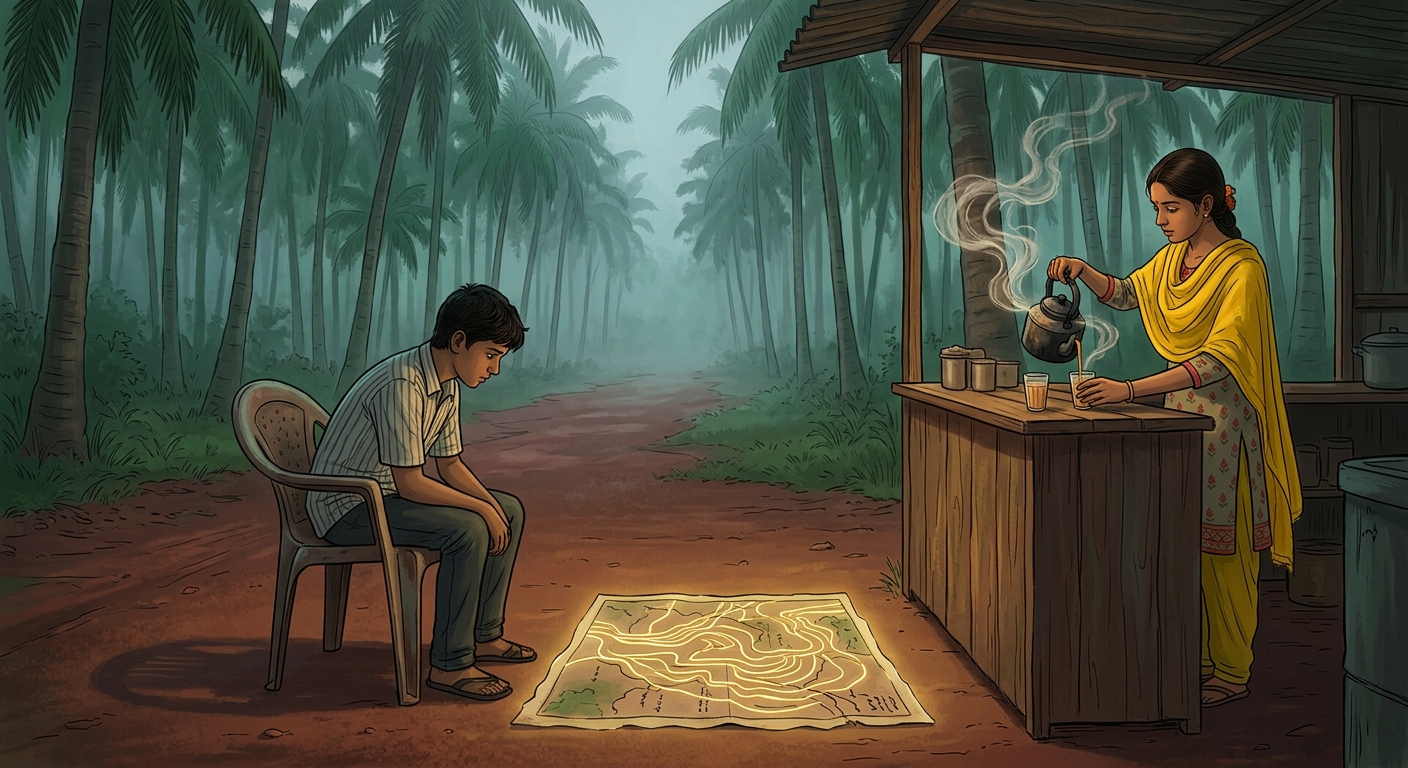
The map is drawn on the back of an electricity bill, the kind with the red stamp that says FINAL NOTICE. The ink is gold.
The funeral is over. The smell of camphor is still on my shirt. I can't wash it out — I tried, last night, in the bathroom sink with Lifebuoy soap until my knuckles were raw. The smell stayed. Camphor and something else, something older, the specific sweat of a body that has been burning.
I am walking.
This is the important thing. I am walking because stopping means standing still and standing still means thinking and thinking means the funeral again — the temple courtyard, the sandalwood pyre, the sound Ammachi's bangles made when they cracked in the heat. I did not cry. I am furious about this. A proper grandson would have cried. A proper grandson would have screamed, would have thrown himself on the pyre, would have done something other than stand there with his hands in his pockets counting the tiles on the temple floor. One hundred and twelve. I counted one hundred and twelve tiles and I did not cry.
The road is in my back pocket. The ration card — no, the electricity bill, I keep getting this wrong — is in my front pocket. Ammachi gave them to me three weeks before she died, in the hospital, with the IV line in her hand and the television on in the corner playing some serial where a woman was slapping another woman. She pressed the folded paper into my palm and said, *Arjun, moné, when you are ready to stop being angry, walk this. The road will find you.*
I am not ready. I am walking anyway.
The road is not on Google Maps. I checked. I checked four times, zooming in and out of the satellite view of Thiruvananthapuram like a madman, looking for something that is not there. The road exists between the old Shiva temple and the coconut grove where they found the dead dog last monsoon. You have to walk past the grove, past the well with the green algae, past the place where the auto-rickshaw drivers park when they are too drunk to drive. Then you turn left at the banyan tree that looks like it is reaching for something, and the road begins.
The first thing I notice: the air changes. It is May in Kerala. May is supposed to be hell — forty degrees, humidity that makes your shirt stick to your back like a second skin, the kind of heat that makes the dogs lie in the gutters with their tongues out, too hot to bark. But here, on this road, the air is cool. Not pleasant-cool. Wrong-cool. Like walking into a room where someone has just died and the fan is still on.
I pull out the map.
Ammachi's handwriting. Cramped, precise, the Malayalam letters leaning slightly to the left the way she always wrote them, as if the words were in a hurry to get somewhere. The roads are drawn in gold ink — real gold, I think, the kind that comes in those tiny tubes you buy at the craft store in Palayam. She drew this on the back of an electricity bill from 1971. The bill is for twelve rupees and forty paise. The stamp says FINAL NOTICE. Under the roads, in her handwriting: *The Fourth Road. For Arjun. When he is ready.*
The ink has not faded. Forty-three years, and the ink has not faded.
There are four branches. I can see them clearly — four roads diverging from a single point, like a compass rose drawn by someone who has never seen a compass. The first branch is labeled *Jeevikkunnavar* — the living. The second is *Marichavar* — the dead. The third is *Aathmakkal* — the spirits. The fourth branch has no label. It is drawn in a different hand — still Ammachi's, but looser, as if she drew it in a hurry, or in a dream, or after she was already dead.
I am on the fourth branch.
I did not choose it. The road chose me, or the map chose me, or the heat chose me — I was walking and the road branched and I went left, the way I always go left, and suddenly the air was wrong and the light was wrong and the banyan tree behind me had three trunks instead of one. I looked at the map. The fourth branch pulsed once, like a heartbeat, and I understood — with the part of my brain that still believes in ghosts and temple offerings and the specific power of a grandmother's curse — that I was on the road that changes.
*Enthu cheyya.* What to do. The phrase comes out in Malayalam, in my head, the way Ammachi used to say it when the monsoon flooded the kitchen or the electricity went out for three days or my father called from Dubai to say he was not coming home for Onam. *Enthu cheyya.* A question that is also a surrender. A shrug in two words.
The road is made of packed red earth, the kind that turns to mud in the monsoon and dust in the summer. But here it is neither summer nor monsoon. Here it is something else — the air smells like rain that has not fallen yet, like the moment before lightning, like the inside of a temple when they open the inner sanctum and the smell of old stone and ghee and something electric pours out. The trees on either side are coconut palms, but they are wrong — too tall, too straight, their fronds moving in a wind I cannot feel. The sound they make is not the usual rustle. It is a whisper. It is almost words.
I walk for what feels like an hour. The road does not change. The light does not change. My phone has no signal — I checked, twice, the way you check a pulse on someone you are not sure is dead. The Nokia screen says NO NETWORK. The battery is at sixty-seven percent. I have been walking for an hour and the battery has not moved from sixty-seven percent. This is the first thing that scares me.
The second thing that scares me: there are no people. No auto-rickshaws. No cows. No dogs. No sound of traffic, no sound of construction, no sound of the mosque's azan or the temple bell or the church bells from the Syrian Orthodox church near my house. The only sound is the coconut palms whispering and my own footsteps on the red earth and, somewhere behind me, the sound of something following.
I do not turn around. Ammachi taught me this. *Don't turn around, moné. If something is following you, let it follow. Turning around gives it permission.*
I walk faster.
The road curves. The map shows the curve — a gentle bend to the right, drawn with the precision of someone who has walked this road a hundred times. In the margin, next to the curve, a note in Ammachi's handwriting: *The banyan tree here has a face. Don't stare at it.*
I look up. The banyan tree has a face.
It is not a face the way you think of a face — two eyes, a nose, a mouth. It is a face the way a knot in wood is a face, the way a stain on a ceiling is a face — you see it and you cannot unsee it. The bark has folded in on itself in a way that suggests eyes, a suggestion of a nose, a mouth that is open in a shape that could be a scream or a song. The roots are thick and twisted, reaching into the red earth like fingers. I do not stare at it. I look at the ground and I walk past it and I do not breathe until I am ten steps beyond.
*Good boy,* the margin says. The ink is fresh.
I stop. I stare at the map. The ink is fresh — wet, glistening, the gold catching the light in a way that ink that has been on a forty-three-year-old electricity bill should not catch the light. I touch it with my thumb. It smears. It is wet. It is new.
Ammachi has been dead for three months.
The road opens up. The coconut palms thin out, and there is a clearing — a crossroads, a place where four paths meet. In the center of the clearing is a wooden structure, a kind of stall, with a tin roof and a counter and a single gas stove with a blackened pot on it. The smell hits me before I see the girl — chai, the real kind, the kind you make with loose tea leaves and whole milk and a handful of cardamom pods crushed with the back of a spoon. The kind Ammachi made on Sunday mornings when I was small enough to sit on her lap.
The girl is sitting on a plastic chair behind the counter. She is sixteen. She looks sixteen — the hair in a long braid, the school uniform skirt, the Nokia phone in her hand that is the same model as mine. She looks like she could be in my class at school. She looks like she has been sitting in this chair since before the school was built.
"You're late," she says.
I open my mouth. I close it. I open it again.
"Late for what?"
She laughs. She laughs at something behind my shoulder. I do not turn around.
"Sit down," she says. "I'll make you chai."
I sit. The plastic chair is warm, as if someone has just been sitting in it. The counter is made of old wood, the kind that has been scrubbed so many times the grain stands up like the hair on a dog's back. There are two cups — steel tumblers, the kind you get in darshini hotels in Bangalore, dented and worn. She pours the chai from the pot. The steam rises. The smell is Ammachi's kitchen — jeera and cardamom and the specific burn of over-boiled milk.
"What is this place?" I ask.
"The crossroads," she says. She does not look at me. She is looking at the map, which has opened itself on the ground between us. I did not take it out of my pocket. It is on the ground, open, the gold ink glowing faintly in the light that is not sunlight and not lamplight and not anything I have a word for.
"Your grandmother walked here," the girl says. "A long time ago. Before I had the stove."
"How long have you been here?"
She smiles. It is the smile of someone who has been asked this question before, many times, and has never given the same answer twice.
"Longer than the crossroads," she says. "Longer than the banyan tree. Longer than the road."
She pushes the tumbler of chai toward me. The steam smells like Ammachi's kitchen. The map on the ground is glowing. In the margin, in fresh ink, in my grandmother's handwriting, a new note:
*She will ask you about the fourth branch. Tell her the truth.*
I have not told anyone about the fourth branch. I have not known there was a fourth branch until today.
The map is a system. Ammachi drew it the way you document a complex machine — each branch labeled, each danger marked, each path annotated with the care of someone who has walked it and survived. The four branches are four states: the living, the dead, the spirits, and the changing. The fourth branch is the one that rewrites itself. The one that is never the same twice. The one that requires you to carry a map that talks back.
The map is a conversation. It is not a guide — it is a dialogue between the dead and the living, between the grandmother who drew it and the grandson who walks it. The margin notes are her annotations, her warnings, her jokes. The ink is fresh because the road is alive. The road changes because the map changes. The map changes because Ammachi is still, in some way, still walking it.
Arjun is the new user. He is angry. He is untrained. He is inheriting a system he did not ask for, a road he does not understand, a map that knows more than he does. He is walking the fourth branch because he does not know how to stop. He is walking because stopping means thinking and thinking means the funeral again.
The Fourth Road is live. The first chapter is a map, a funeral, a girl at a crossroads, and a cup of chai that smells like a dead woman's kitchen. The reader walks with Arjun into a world that was built for him, by someone who is gone. The four branches are established: living, dead, spirits, changing. The fourth branch is the one that rewrites itself. The margin notes are the grandmother's voice, still present, still annotating, still warning.
The world is Kerala in May — the heat, the coconut palms, the red earth, the smell of camphor and chai. The spirit world is not separate from the natural world; it is an extension of it. The road is made of packed earth and old stone and the specific humidity of a place that has seen monsoons for a thousand years. The map is drawn on the back of an electricity bill from 1971. The ink is gold. The ink has not faded.
The voice is established: Arjun's first-person narration, angry and precise, funny when he is scared. Malayalam words untranslated, meaning made clear by context. The humor is a shield. The reverence breaks through when he is not paying attention. Kavitha is introduced — sixteen, old, a fixture, a threshold. She serves chai and asks questions that have no easy answers. The map speaks in margin notes, in fresh ink, in a handwriting that should not be possible.
The hook is set: the map has opened itself on the ground. The margin note says to tell the truth about the fourth branch. Arjun does not know the truth. He does not know there was a fourth branch until today. The reader is invited to walk with him, to find out what the fourth branch is, to find out what the map knows, to find out why Ammachi drew it and what she was trying to say.
The chai is poured. The steam rises. The map glows. The road waits.
Next time
The chai is cold. The map has changed again. Kavitha tells Arjun the names of the four branches — Living, Dead, Spirits, Changing — and he does not believe the fourth one is real. She says: "Walk it and find out." He walks it. The road is made of his grandmother's voice, and it is telling him something he does not want to hear. The margin note in his grandmother's handwriting says: *I'm sorry, moné. I should have told you about this place before.* The fourth branch is the one that changes. The map redraws itself in gold ink. The margin notes are fresh. The road is longer than he thinks. The chai is cold. The girl is waiting. The question is not whether he will walk the fourth branch. The question is whether the fourth branch will let him leave.
Comments
0Sign in to leave a comment.
No comments yet. Be the first to share your thoughts.
Chronicle