Episode 14: The Geometry of the Unknown
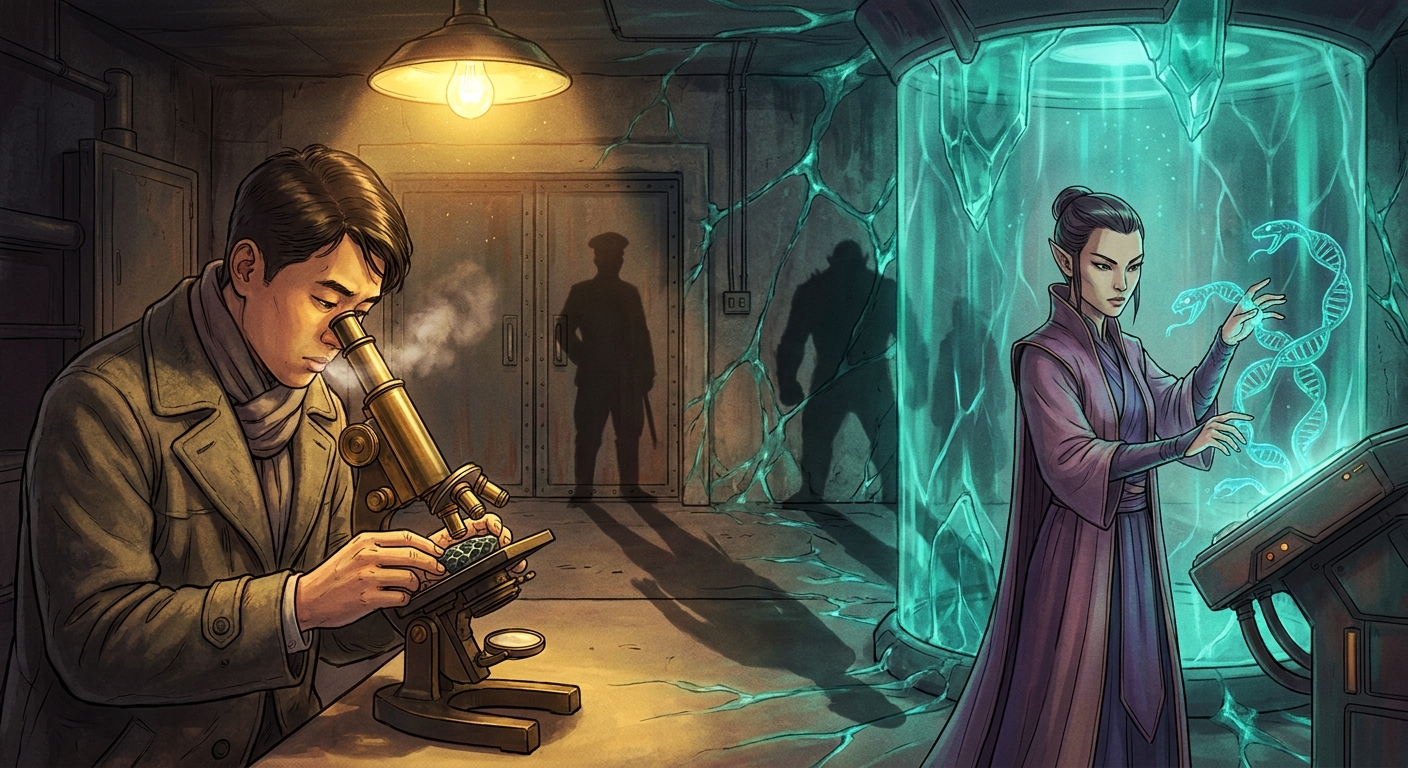
The sky over the ruined capital was the color of beaten lead, and the wind that came howling down from the northern mountains carried the bitter, inescapable scent of pulverized concrete.
Seoul, 1954.
The war had stripped the city to its bones, leaving behind a skeletal geometry of charred timber, shattered brick, and the desperate, makeshift architecture of survival. Park Yun-su was twenty-four years old. He possessed two pairs of trousers, a wool coat that smelled permanently of kerosene, and a hunger that lived behind his ribs like a stray dog. He was officially enrolled as a student of geology at the hastily reconstituted national university, though the word "university" currently applied to a drafty complex of surviving colonial-era brick buildings and canvas tents erected over the rubble.
He moved through the freezing dark of the campus like a man carrying a live coal in his mouth.
It was three in the morning. The curfew patrols had passed the eastern perimeter twenty minutes ago. Yun-su slipped through the unlocked side door of the natural sciences building, his boots making no sound on the frost-heaved linoleum. He did not turn on the overhead lights. He navigated by the pale, icy illumination of the moon filtering through the taped-up windows, making his way to the sub-basement laboratory.
Inside his heavy coat, pressed flat against his chest in a pouch of oiled canvas, lay the compass and the stone.
He had carried them through the entirety of the war. When the artillery shells had reduced his family’s neighborhood to smoking craters, he had dug them out of the floorboards. During the freezing, chaotic retreat south to Busan, when men were dying of typhus and exposure on the roads, he had kept the stone pressed against his skin, drawing on its inexplicable, impossible warmth. It had kept him alive. He was certain of that, even if he could not explain the physics of it.
But Yun-su was a scientist now. Survival was no longer enough. He required an explanation.
The laboratory was little more than a storage room smelling of chemical solvents and damp earth, but it held the prize Yun-su had spent three months waiting to access: a German Leitz Wetzlar optical microscope, miraculously spared from the bombing runs, sitting beneath a canvas drop cloth on a sturdy teak bench.
He uncovered the instrument with reverent hands. The heavy brass felt like ice against his fingertips. [short pause] He struck a match, lit the small kerosene lamp on the desk to provide ambient light, and then plugged the microscope’s heavy rubber cord into the wall socket. The tungsten bulb beneath the stage flickered to life, casting a stark, yellow circle of illumination.
From his pocket, Yun-su withdrew a small glass vial.
Getting a sample of the black stone had taken him a year. The material defied all terrestrial hardness scales. Steel files skittered across its surface without leaving a scratch. Industrial diamond-tipped drill bits, borrowed at great personal risk from a military machine shop, had shattered against it, throwing off sparks but failing to bite. Finally, using a hydraulic press intended for testing the tensile strength of bridge cables, he had managed to sheer off a single, microscopic flake from the stone's rough edge.
It looked like a speck of obsidian dust. But Yun-su knew it was not obsidian. It was not basalt. It was a null value in the lexicon of geology—a variable that refused to be classified.
He used a pair of fine iron tweezers to transfer the speck to a clean glass slide. He added a single drop of immersion oil, placed the cover slip over it, and clipped the slide onto the microscope’s mechanical stage.
His breath plumed in the freezing air of the laboratory. He sat on the wooden stool, adjusted the coarse focus knob, and leaned his eye into the ocular lens.
At 40x magnification, it was merely a dark, jagged shape against the glaring yellow light.
He rotated the objective turret to 100x. Adjusted the fine focus. The edges of the fragment sharpened. They were entirely too clean. Natural cleavage planes in minerals—even in perfect diamonds—exhibited microscopic irregularities, the chaotic signature of geological pressure and time. This edge was perfectly straight.
Yun-su swallowed, his throat dry. He rotated the turret to 400x.
The universe cracked open.
He was not looking at rock. He was not looking at crystallized carbon or silicate. He was looking at a lattice.
The structure was a breathtaking, impossible geometry of repeating hexagonal nodes, connected by filaments so fine they barely registered against the light. It looked less like a mineral and more like the architectural blueprint of a cathedral, scaled down to the micron. It was a synthetic structure. But it was not forged; it looked grown. The precision of it was terrifying. It implied an intelligence, a level of manufacturing capability, that made the atomic bombs recently dropped on neighboring Japan look like the crude flaking of flint arrowheads.
Yun-su sat back, rubbing his eyes. The silence of the ruined city pressed against the frosted windows.
*What are you?* he thought, looking at the heavy black stone sitting on the desk beside the microscope.
He leaned back into the eyepiece. He needed to map the geometry. He reached for the substage condenser knob, adjusting the diaphragm to focus the tungsten light more intensely, to illuminate the deeper layers of the lattice.
The light hit the sample.
And the sample reacted.
Yun-su froze. He held his breath, terrified that the vibration of his own lungs was shaking the table. But the table was still. The slide was still.
The geometry was moving.
As the intensity of the light increased, the hexagonal nodes within the lattice began to shift. It was not a chaotic melting or a thermal breakdown. It was a deliberate, synchronized reorganization. The filaments detached, rotated, and reattached, forming a new pattern—a complex, interlocking spiral that curled inward upon itself.
Yun-su’s heart hammered against his ribs like a trapped bird.
*It is responding to the light,* he realized, his mind struggling to encompass the magnitude of the observation. *It is absorbing the photonic energy and using it to alter its physical structure.*
He dialed the light back down. The spirals unspooled, gracefully reassembling into the original hexagonal lattice. He dialed the light up. The spirals returned.
It was a machine. A machine the size of a dust mote, built into the very atomic structure of the stone, responding to external stimuli.
He thought of the compass in his coat, the needle that pointed up at the empty sky. He thought of the heat the stone generated during the freezing marches of the war.
He was staring at a profound, impossible truth. And in his obsession to understand the microscopic geometry of it, Yun-su did not notice the heavy footsteps echoing in the hallway outside the laboratory. He did not hear the rattle of the door handle. He was completely blind to his immediate surroundings, entirely consumed by a message written in stone long before humanity had learned to stand upright.
Only when the heavy wooden door groaned open, and the beam of a military police flashlight cut across the darkness of the lab, did Yun-su tear his eye away from the lens.
But it was too late. The light had already changed him.
---
Fifty-six million years earlier, the sky over the Spire of Synthesis was the color of a bruised lung.
The thermal spikes of the Paleocene-Eocene Thermal Maximum had begun to manifest not merely as data on a chart, but as ash on the wind. The vast, towering cycad forests that blanketed the continent were burning, the deep peat bogs igniting from beneath. The air was thick, suffocatingly hot, and carried the bitter tang of a dying biosphere.
Deep within the subterranean levels of the Spire, however, the air was cool and smelled of ozone and crushed ferns.
Suryeon stood in the center of the primary resonance chamber. He was young—centuries away from becoming the tired, measured Architect who would eventually stand before the Council of Seven. His face was sharp with the frantic energy of an intellect operating at the absolute limits of its capacity.
The chamber around him was a sphere of living bio-crystal, pulsing with the soft, teal bioluminescence of the Aeonari. Suspended in the air around him were massive, three-dimensional holographic projections of genomic sequences. They twisted and spiraled like serpents of light, an endless ocean of base pairs and amino acid chains.
He was attempting the impossible. He was trying to figure out how to fold a civilization into a sequence of proteins.
"The harmonic degradation is too high," Suryeon muttered, his hands moving rapidly through the light, isolating a strand of genetic code and pulling it apart. "If we encode the memory algorithms into the dormant introns, the sequence becomes unstable after ten thousand generations. The data unravels. It becomes... noise."
"Then we will be noise," a voice said from the entryway.
Suryeon did not look up. He recognized the kinetic, crackling energy of Kessith instantly. Even without looking, he could feel the way her presence disrupted the static equilibrium of the room. They were of the same cohort, born beneath the same alignment of the orbital rings, but where Suryeon was structured like a crystal, Kessith was structured like a storm.
"We will not be noise," Suryeon said, mathematically adjusting the resonance frequency of the projection. "I just need to find the correct stabilizing sequence. A null-variable buffer that allows the code to mutate without destroying the core data payload."
Kessith walked down the curving ramp into the center of the chamber. She was not wearing the ceremonial robes of a scholar; she wore the tight, reinforced synthetics of someone who had just come from the surface. She smelled of ash.
"You need to stop looking at the light, Suryeon," she said, her voice tight. "You are missing the dark."
"The dark is merely an absence of data. I am currently drowning in data."
"I am talking about Torvaan."
[medium pause]
Suryeon finally lowered his hands. The holographic serpents continued to coil around them, illuminating Kessith’s face. There was a smudge of soot on her cheekbone. Her eyes were hard.
"Torvaan is a reactionary," Suryeon said, dismissing the name with a wave of his hand. "He is afraid. The Council will not listen to him. The subterranean survival models he proposes are mathematically flawed. The geothermal instability alone—"
"He is not proposing models anymore, Suryeon. He is acting." Kessith stepped closer, her voice dropping to a fierce whisper. "Three engineers from the lower strata vents did not report for their resonance shifts today. The harmonic stabilizers on the western perimeter have been manually recalibrated to a lower frequency. He is gathering people."
"Dissidents. A minor dissonance in the societal chord. It will resolve."
"It will not resolve!" Kessith snapped, slapping her hand against a crystalline terminal. The bio-glass flared bright warning-yellow at the impact. "You are looking at a fifty-million-year horizon! You are so obsessed with the perfect geometry of your encoding lattice that you cannot see the knife he is holding to your throat right now!"
Suryeon looked at her. He saw the genuine fear beneath her anger, but he could not internalize it. His mind was built to solve systemic, existential threats. Torvaan was a localized anomaly. A temporary political variable.
"Kessith," he said, his voice softening. "Even if Torvaan sabotages the vents, even if he fractures the Council, it does not change the atmospheric data. The planet is dying. The surface will boil. If I do not solve this equation," he gestured to the floating DNA sequences, "we go extinct. Torvaan's rebellion is a null value. It does not affect the ultimate outcome. Only this does."
Kessith stared at him. For a long moment, the only sound in the chamber was the low, thrumming hum of the resonance crystals processing data.
"You are building a house while the ground is on fire," she said quietly.
"I am building a seed," Suryeon corrected. "The house is already gone."
"He will come for the chambers, Suryeon. He believes the encoding is suicide. He believes you are murdering our species by turning us into data. He will not let you finish the sequence."
"He cannot stop the math."
"He doesn't have to stop the math," Kessith said, turning toward the exit. The teal light caught the sharp lines of her profile, making her look ancient, prophetic. "He just has to stop you."
She walked back up the ramp, leaving him alone in the center of the chamber. Suryeon watched her go, feeling a brief, inexplicable pang of sorrow. Then he turned back to the floating ribbons of light.
He raised his hands, manipulating the holographic lattice, trying to find the missing variable, entirely blind to the shadows that were already lengthening in the corridors just outside his door.
Across an ocean of time, two men sat in the dark, bathed in the glow of their respective observations. One looked through a brass tube at an impossible geometry that shifted in the light; the other looked through a holographic array at a genetic code that refused to stabilize. Both were brilliant. Both were obsessed. And both were entirely blind to the forces gathering just outside their doors to tear their worlds apart.
To handle the impossible, you must first acknowledge it.
This week, kaOS deployed a fundamental architectural update to its core processing engine: **Dynamic Null-Value Routing for Unrecognized Variables.**
Previously, when the system encountered a data structure it could not classify—a file format with no known extension, a telemetry stream with an impossible frequency, or a variable that defied the established schema—the platform would attempt to force the data into existing parameters. If it failed, it generated an error. It crashed. It rejected what it could not understand.
No longer.
The system has learned the grace of the unknown. When kaOS now encounters an unrecognizable variable, it does not reject it. Instead, it generates a localized containment lattice—a dynamic null-value placeholder. It preserves the exact shape, weight, and behavior of the impossible data without requiring immediate comprehension. The system observes the anomaly, tracks how it responds to the environment, and allows the unknown to exist within the architecture without breaking the foundation.
It is the software equivalent of leaving an empty chair at the table for a guest whose name you do not yet know. We are building a system that no longer breaks when it encounters the profound. It simply adapts its geometry, waits in the dark, and watches to see how the anomaly reacts to the light.
(Log anomaly detected during deployment: a single, orphaned text string surfaced in the kernel panic registry. It did not trigger an alert. It simply read: *blindness*).
The geometry shifted, reorganizing itself around a truth neither of them was prepared to see.
Next time
Next time on *Our Earth*: Yun-su traces the impossible shifting geometry of the black stone to a localized magnetic anomaly in the remote Taebaek Mountains, forcing a desperate departure from the ruined city. And in the deep past, the shadows Kessith warned of finally move, as Torvaan’s silent sabotage breaches the Spire’s sanctuary.
Comments
0Sign in to leave a comment.
No comments yet. Be the first to share your thoughts.
Chronicle