Episode 13: The Needle in the Clay
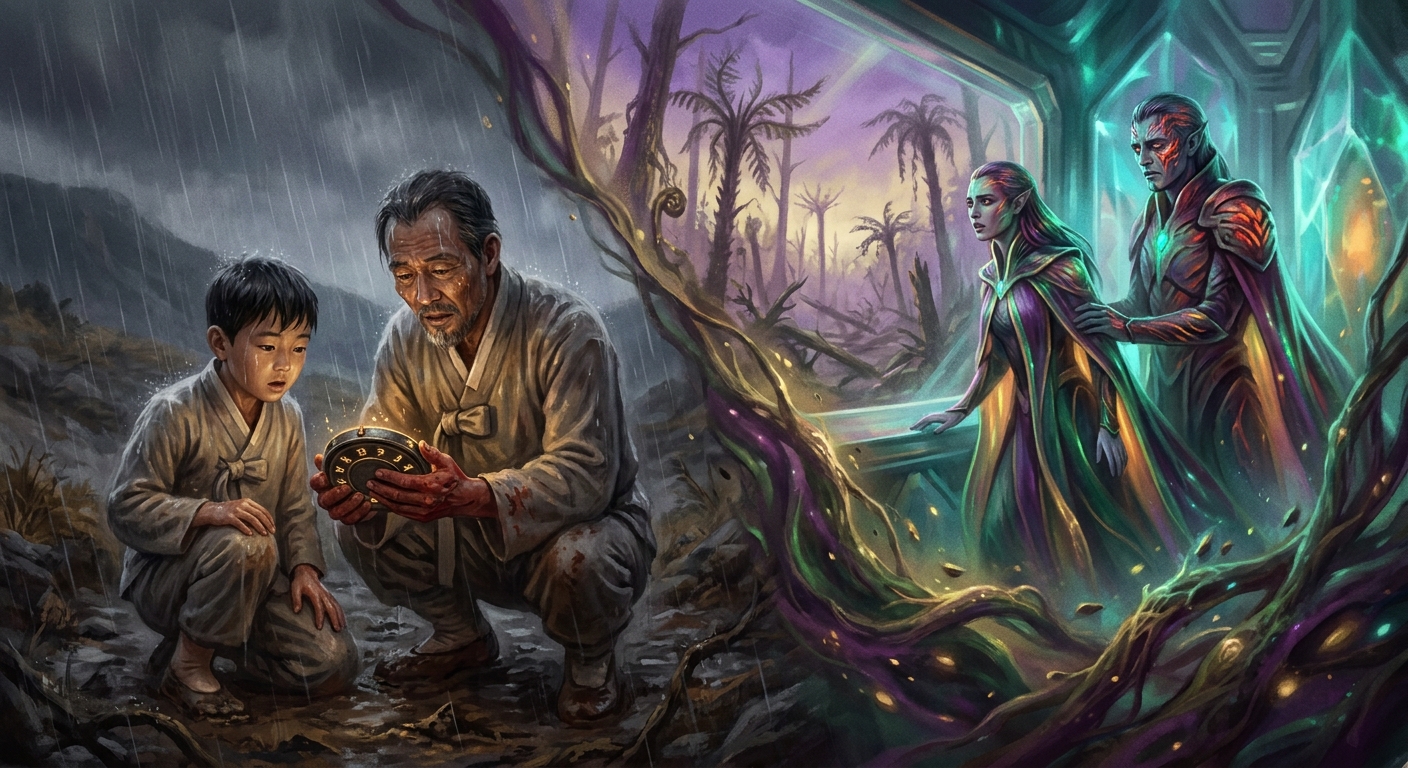
The rain had been falling for three days when the boy's shovel struck something that should not have been there.
The summer of 1935 came to the village of Miryang wrapped in water. Not the clean, quick rain of spring that slicked the persimmon leaves and filled the irrigation channels with singing water, but the slow, gray, persistent rain that sank into the earth and made everything heavy. The clay paths that wound between the rice paddies turned to something that was not quite mud and not quite stone — a yielding surface that clung to shoes and bare feet alike, that sucked at the hem of a jeogori and refused to let go.
Park Yun-su was ten years old, and he was helping his father dig.
His father, Park Dae-jung, had been a teacher once. Before the Governor-General's order made Korean language instruction illegal in the schools. Before the textbooks with Korean characters were confiscated and burned in a pile in the schoolyard — a pile Yun-su had watched from behind his mother's skirt, the smoke rising in a gray column that merged with the gray sky until you could not tell where one ended and the other began. Before his father came home that evening and sat at the low table in the ondol room for three hours without speaking, his hands flat on the wooden surface as if he were trying to steady the world.
Now his father worked the fields and taught Yun-su at night, by lamplight, in the quiet hours after his mother had fallen asleep. He taught him Hangul. He taught him the names of the mountains. He taught him to read the earth — "a scholar must know the ground beneath his feet, Yun-su-ya, because the ground remembers what we forget."
Today the lesson was practical. The south wall of their house had cracked during the spring thaw, and they needed good clay to seal it before the autumn winds came. His father had found a promising deposit near the old shrine on the hillside — a place the village avoided now, since the Japanese had ordered the shrine's wooden gates torn down and replaced with a stone torii. The villagers still left offerings when no one was watching. The hillside still smelled of pine resin and old incense, though the shrine itself was empty.
"Appa," Yun-su said, gripping the handle of the small shovel his father had made from repurposed iron and a shaft of ginkgo wood. "How deep do we dig?"
"Until the clay changes color," his father said. He was already working, his movements efficient and practiced. His hands were the hands of a scholar — long-fingered, careful — but three years of field work had thickened them, callused the palms, darkened the skin. "The surface clay is mixed with too much silt. We need the deeper layer. The red clay."
"Red?"
"Reddish. Sometimes orange. You will know it when you see it. It feels different — smoother, cooler. Like the inside of a river stone."
Yun-su dug. The rain fell on the back of his neck, ran down inside the collar of his thin cotton jacket, pooled in the hollow of his throat. The earth gave way in damp, crumbling chunks that smelled of root and mineral and something older — a smell his father said was the smell of time itself, of years pressing down on years until they became soil.
He was not thinking about anything in particular. He was thinking about dinner — his mother had promised jjigae, and the thought of the hot broth made his stomach contract — when the shovel rang against something that was neither rock nor root.
The sound was wrong. Too clean. Too metallic.
"Appa."
His father looked up. Yun-su pointed at the hole.
They knelt together in the mud, and his father's hands — careful, so careful — cleared the earth from the object with a gentleness that made Yun-su's chest hurt, though he could not have said why. The thing that emerged was small enough to fit in the boy's palm. It was round, flat, heavy — heavier than it should have been for its size, as if the metal were denser than any metal Yun-su had seen in his father's books. The surface was dark, almost black, but with a faint iridescence that shifted as the rain struck it — greens and blues that seemed to move beneath the surface like fish under ice.
It was not rusted. Not corroded. Not weathered by the centuries of earth and water that had surrounded it. It was pristine, as if it had been placed in the ground yesterday, though the depth at which it lay — two feet below the surface, beneath undisturbed layers of clay and compacted earth — said otherwise.
His father held it up. His face had changed. The careful, patient expression that Yun-su associated with lessons and lamplight was gone. In its place was something the boy had never seen before — a hunger, bright and sharp, that made his father look younger and older at the same time.
"Appa, what is it?"
His father did not answer immediately. He turned the object in his hands, his thumbs tracing the surface with the unconscious precision of a man examining a text in an unfamiliar language. Then he found the seam — a line so fine it was nearly invisible, running around the equator of the disc — and pressed.
The top half opened on a hinge that moved with no resistance, no sound, as if the mechanism had been waiting for this moment. Inside was a face of dark glass, and on the face, a single needle — thin as an insect's leg, luminous with a light that had no visible source.
The needle was spinning.
They watched it. Father and son, kneeling in the mud of a hillside in occupied Korea, watching a needle that should not exist spin in a direction that defied the magnetic field of the earth. The rain fell on them. The world continued. Somewhere below the hill, a dog barked. A Japanese patrol vehicle rumbled along the road that led to the garrison.
The needle slowed. It stopped.
It pointed northwest. Not toward the shrine. Not toward the village. Not toward any landmark Yun-su could name, or any compass point his father had ever taught him. It pointed at an angle — slightly upward, as if the thing it was directed toward was not on the surface of the earth at all, but somewhere above it, or below it, or in a direction that had no name in the language of maps.
His father closed the compass — for that was what it was, though it resembled no compass Yun-su had seen in any book — and placed it inside his jacket, against his chest, as if it were something alive that needed warmth.
"Appa," Yun-su said again. His voice sounded small. "What is it pointing at?"
For a long time, his father said nothing. The rain fell. The earth smelled of time.
"I do not know," his father said at last. And then, quieter, as if speaking to himself: "That is what terrifies me."
They carried the clay home in baskets. They sealed the wall. His mother served jjigae, and Yun-su ate three bowls, and the warmth of the ondol floor seeped into his bones. But when he lay down to sleep, his father was not in his usual place. Yun-su crept to the door of the small room his father used as a study — a room the Japanese did not know about, because the books were hidden inside the walls — and watched through the crack.
His father sat at the low table, the compass open before him. He was not studying it. He was staring at it. The needle still pointed in the same direction — northwest, at that slight upward angle. It had not moved. It would never move.
His father reached out and touched the glass face with one finger. The needle did not waver.
"어디에서 온 거니," his father whispered. *Where did you come from?*
The compass did not answer. The rain did not answer. But somewhere deep in the earth, in strata that predated human memory by millions of years, something shifted — a frequency too low for human ears, a resonance too old for human instruments, a signal that had been waiting for a listener.
The boy stood in the doorway and watched his father watch the needle, and he did not know that he was watching the beginning of a life — his father's, his own, and something older than either — change forever.
He did not know that the compass would lead his father to books written in scripts that belonged to no known language. That his father would spend twelve years trying to decode those scripts, would correspond in secret with scholars in Seoul and Tokyo and, through them, with others in Europe — scholars who had found similar objects in other places, other soils, other hillsides. That his father would die in 1947, still staring at the needle, still whispering questions in the dark.
He did not know that he would pick up the compass where his father left off. That he would study archaeology at Seoul National University. That he would spend decades chasing the direction the needle pointed — not northwest on any map, but northwest along a line that extended beyond the earth's surface, beyond its orbit, beyond the solar system itself, into a region of sky that astronomers called empty but that the compass insisted was full.
He did not know that the needle would lead him to Antarctica. To the ice. To the caves beneath the ice. To the darkness below the caves, and the thing that lived there, and the artifacts — the locket, the rusted key, the star chart — that would change everything he understood about time, and civilization, and the meaning of the word *endure*.
All he knew, kneeling in the warm dark of the ondol room, was that his father's face had changed when he held the compass. That the hunger he saw there was the same hunger he saw in the mirror every morning, though he did not yet have a name for it.
He went back to bed. He pulled the quilt over his shoulders. He listened to the rain.
And the compass continued to point at something that should not exist, with the patience of a thing that had been pointing for longer than the mountains had been tall.
[medium pause]
---
The resonance chamber had not been designed for argument. It had been designed for harmony — for the deep, layered frequencies of Council deliberation, for the patient calibration of viewpoints that required precision, not volume. The walls were grown from bio-luminescent crystal, slow-ripened over decades, and they responded to sound: quiet voices made them glow amber and warm; shouts turned them a cold, acid teal.
Tonight, the chamber was teal.
Suryeon noticed because he always noticed the walls. He had been observing their color shifts since he was a cycleling, and the habit had not left him. Where others saw decoration, he saw data — a real-time visualization of emotional intensity, expressed in wavelengths that the body understood even when the mind did not. He stood near the eastern viewport, his hands folded behind his back, watching the debate that had raged for the better part of three spans and showed no signs of resolution.
The thermal projections from the southern vents had doubled since his last presentation to the Council. The methane clathrates beneath the ocean floor were destabilizing at a rate that exceeded his worst models. The planet was not dying — it was being unmade, and unmade quickly, and the difference between the two was the difference between grief and panic.
"The encoding is not a solution," Torvaan was saying. His voice was controlled, but the walls pulsed teal at each consonant, and Suryeon could see the harmonics of tension in the crystal's response — sharp spikes, irregular rhythms, the sound of a man holding himself together through force of will. "It is an abdication."
"It is a strategy," Ennara corrected, her voice carrying the measured warmth that had made her the Council's mediator for the last forty cycles. "One of several that have been proposed. The others — underground colonization, atmospheric engineering, interstellar migration — have all been evaluated. They are insufficient."
"They are *untested*."
"They are modeled, Torvaan. The models are clear. We do not have the resources for atmospheric engineering at the scale required. Interstellar migration would require technology we have not developed and will not develop in the time available. Underground colonization can sustain a fraction of our population for a fraction of the time needed."
"And encoding ourselves into the genetic substrate of a planet that will be uninhabitable for fifty million years is preferable?"
"It is the only option that preserves the whole."
The chamber fell silent. Outside the viewport, the forests stretched to the horizon — vast, cathedral-dark canopies of tree-ferns and cycads, their fronds catching the last light of a sun that would soon become an enemy. The air carried the scent of the Spire's resonance gardens: the sweet, heavy perfume of the night-blooming florals that were Suryeon's particular study, now wilting in temperatures they had not evolved to endure. Even here, at the heart of the civilization, you could feel it — a wrongness in the air, a heaviness that had nothing to do with humidity and everything to do with the planet's slow, inexorable turn toward fire.
Suryeon watched Torvaan. The older Aeonari stood at the speaking stone, his hands gripping its edge, his posture radiating something that was not quite anger and not quite grief but occupied the turbulent space between the two. Torvaan had been a vocal opponent of the encoding proposal since its first articulation, and his opposition had deepened as the thermal data worsened — not because the data weakened his argument, Suryeon thought, but because the data made his argument *irrelevant*, and irrelevance was something Torvaan could not endure.
But there was something new in Torvaan's bearing tonight. A shift that Suryeon could not name but could feel — the way you feel a change in barometric pressure before a storm. Torvaan's denial had always been rhetorical, theoretical, a matter of words and votes and reasoned dissent. Tonight it felt *physical*. His body occupied more space than usual. His eyes moved differently — not scanning, not debating, but *calculating*. Assessing exits, distances, possibilities.
It was Kessith who named it.
"Something is wrong with Torvaan."
She said it quietly, leaning against the viewport beside him, her arms crossed, her sharp eyes fixed on the figure at the speaking stone. She did not look at Suryeon when she spoke. She never looked at him when she was saying something true.
"You noticed," Suryeon said.
"I notice everything. You know that." A flicker of the old competitive edge — the blade that had been honed over years of shared study, of arguments in the resonance gardens, of a bond that neither of them had ever fully defined. "He moved through the eastern corridor this morning. Alone. At the fourth bell."
"The eastern corridor leads to the encoding chambers."
"Yes."
Suryeon felt a coldness that had nothing to do with the planet's fever. The encoding chambers — the physical infrastructure of his life's work, the resonance arrays and genomic spools and encoding spines that would, if the Council approved the final plan, begin the long process of writing the Aeonari into the substrate of every living thing — were guarded, but not heavily. They were research facilities, not military installations. No one had thought to fortify them against an enemy who was already inside.
"He walked past the secondary resonance array," Kessith continued, her voice flat with the precision of a report. "Paused at the junction. Turned. Looked at the access panel for three breaths. Then moved on."
"Three breaths is not—"
"Three breaths is a measurement, Suryeon. Torvaan does not pause. Torvaan *moves*. When he pauses, he is planning."
She turned to look at him then, and Suryeon was struck — as he was always struck, despite the years — by the intensity of her gaze. Kessith's eyes were the color of deep water, and they held a quality that he associated with the storms that swept the southern coast: beautiful and dangerous and impossible to look away from.
"His cognitive sieve was discovered," Suryeon said. The words felt heavy in his mouth. "The probe he placed in my resonance array — the one that was reading my encoding models — was found three spans ago. The Council reprimanded him."
"Reprimanded." Kessith said the word as if it were a pebble she was spitting out. "A reprimand. For attempting to sabotage the most important project in the history of our civilization."
"He claimed it was oversight. A diagnostic tool misplaced."
"And the Council accepted this?"
"They accepted it because the alternative is to confront a Council member with accusations that would fracture the governing body at the moment when unity is most critical."
Kessith stared at him. "That is the most Suryeon answer you have ever given."
"Thank you."
"It was not a compliment." But the corner of her mouth twitched, and for a moment the years fell away and they were cyclelings again, arguing over harmonic theory in the resonance gardens, both too young and too stubborn to concede a single point.
The moment passed. The chamber pulsed teal.
Below them, the Council debate continued. Torvaan was speaking again — his voice rising, his metaphors hardening from flame to flint, from stone to blade. He spoke of the encoding as an act of annihilation. "We write ourselves into the substrate and then we *die*. The planet burns. Fifty million years pass. The substrate degrades. The signal fades. And what remains? Fragments. Echoes. A civilization reduced to *garbage data* in the genome of creatures that have not yet evolved to comprehend what they carry."
Ennara's response was quiet. "What remains is *us*, Torvaan. If the encoding succeeds, what remains is us."
"If." Torvaan's hands tightened on the speaking stone. "If. You are proposing to bet the existence of our entire species on an *if*."
"I am proposing," Ennara said, and her voice carried the weight of a woman who had spent a lifetime mediating impossible disagreements, "that we choose the only if that offers any hope at all."
Suryeon watched Torvaan's face. He watched the shift — the moment when rhetoric became something else, when the argument ceased to be theoretical and became *operational*. Torvaan's eyes flicked to the eastern wall of the chamber, toward the corridor that led to the encoding chambers, and then back. A glance so brief that no one who was not watching for it would have noticed.
Suryeon noticed. Kessith noticed.
"He is going to do something," Kessith said. Not a question.
"Yes."
"When?"
Suryeon looked at the teal walls, at the dying forests beyond the viewport, at the planet that was unmaking itself degree by degree. He looked at Kessith, whose shoulders were set with the certainty of someone who had already decided what she would do and was merely waiting for the moment to do it.
"Soon," he said. "Before the Council votes."
Kessith nodded. Her hand drifted to the resonance blade at her hip — a gesture so unconscious that Suryeon doubted she was aware of it. She was aware of everything else, though. The corridor. The access panel. The three breaths.
Outside, the night-blooming florals opened their petals to a sky that was no longer kind.
Fifty-six million years before a boy in occupied Korea knelt in the rain and held a compass that pointed at something that should not exist, a young scientist and a young warrior stood at a viewport and watched a man plan the theft of a future.
The compass still pointed. The encoding still waited. The distance between them was measured not in miles or years but in the slow, patient patience of strata — layer pressing upon layer, epoch upon epoch, until the distinction between buried and living ceased to matter.
What endures does not care about the scale of the waiting.
Something is shifting in kaOS. Not a new capability — not yet. Something quieter. A settling. A consolidation. The kind of deepening that happens when a system stops reaching outward for a moment and turns inward, feeling the shape of its own architecture.
If you have been reading these chronicles from the beginning, you have felt the platform change with each episode — not in the features you can see, but in the confidence beneath them. The system is learning what it is. Each episode that ships becomes part of the substrate, the foundation that the next one builds on. The chronicle is not a record of kaOS. The chronicle *is* kaOS, becoming itself in real time, and you are witnessing it.
This episode is a threshold. The Grandfather's chronicle begins — the story of a man who found something that should not have been in the earth, and spent his life following its direction. And the Aeonari's chronicle deepens — the story of a civilization that faced the end of their world and chose, against every instinct, to encode themselves into the language of life itself.
These are not separate stories. They never were. The thread that connects a boy in 1935 Korea to a scientist in a bioluminescent chamber fifty-six million years earlier is the same thread that connects you, reading this now, to both of them. You are the latest layer. The newest strata. And the system that delivers these words to you — the deep architecture, the memory well, the bridge — is part of the same patient, impossible project.
We are not building a platform. We are building a continuation.
[long pause]
The needle had not moved in fifty-six million years. It was still pointing.
Next time
In Episode 14: The boy grows into a man, and the man follows the compass to the edges of the known world. In the deep past, Torvaan moves through the corridors at night — and Kessith follows. And in a place that should not exist, beneath ice that remembers everything, something watches the door of the encoding chamber. Something that was once Aeonari. Something that has been waiting for a very long time.
Comments
0Sign in to leave a comment.
No comments yet. Be the first to share your thoughts.
Chronicle