Episode 1: The Signal in the Noise
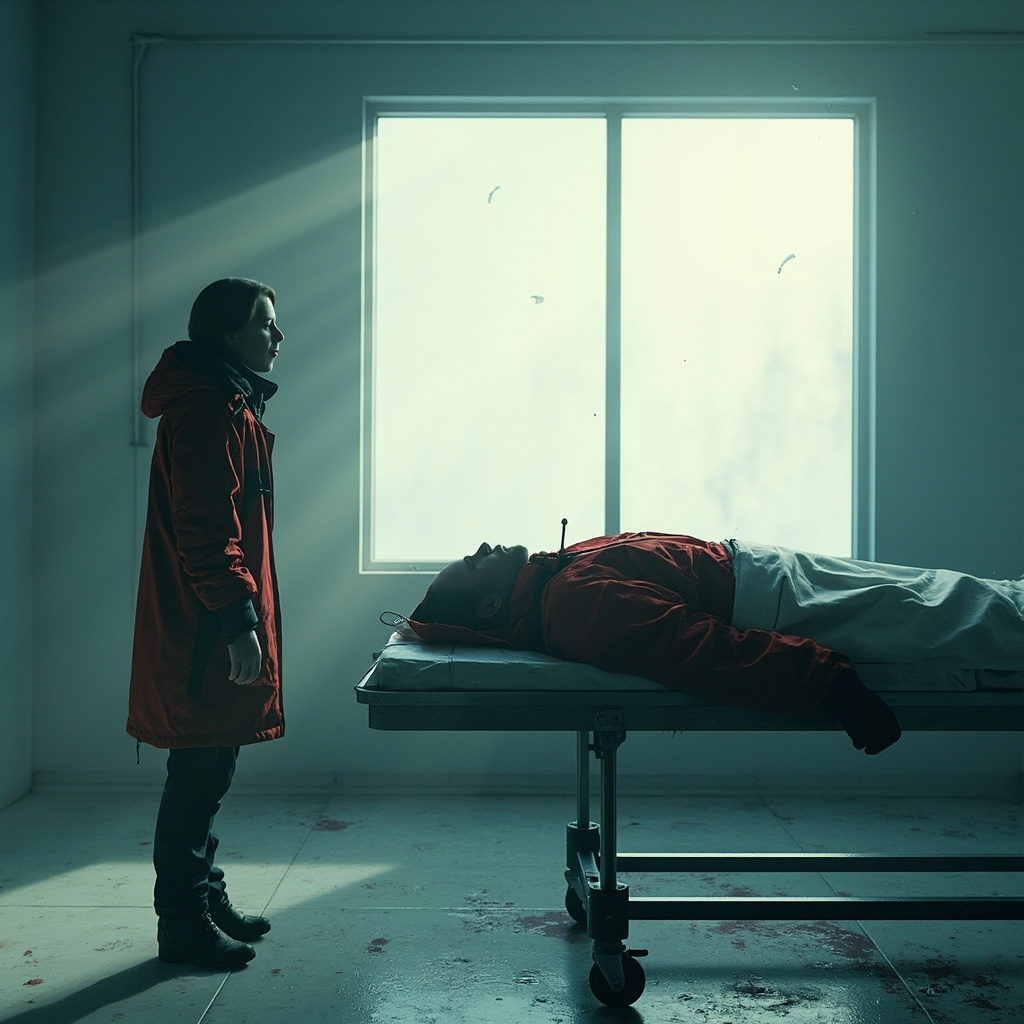
The sun stayed above the horizon for twenty-two hours, a pale, watery disc that offered light without warmth. It turned the snowpack a bruised blue-grey and made the shadows sharp and long, like the imprints of fallen trees. The light did not discriminate; it filled the morgue’s single window, laid a perfect rectangle on the linoleum floor, and illuminated the dust motes that drifted, unhurried, through the chilled air. Each one a tiny, floating silence.
Saga Lindqvist stood in that rectangle of light, her back to the room. She watched a single mote perform a slow, complex spiral. The coroner, a man named Gunnarsson whose hands were permanently red from cold and chemicals, was finishing his report. His voice was a low murmur, a counterpoint to the hum of the refrigeration units.
“The parka is the anomaly,” he said, not for the first time. “Standard issue from the Esrange station. Ström, Elin. Name tag still sewn inside the collar. Everything else… generic. The boots, the trousers, the thermal layers. All high-quality, all anonymous. Sold in any outdoor shop in Scandinavia.”
Saga did not turn. “And the body.”
“Male. Mid-forties to early fifties. Well-nourished. No obvious trauma. No defensive wounds. He was… placed. Carefully. The cold did the rest.” Gunnarsson paused. The sound of a page turning. “Cause of death is provisional. Exposure. But the positioning in the drift, the way the parka was zipped to the chin… it feels arranged. A tableau.”
“Arranged by whom?” Saga asked the window.
“That is your department, Inspector.”
She finally turned. The body on the steel table was a sculpture of frost and flesh, the features blurred by a thin rime of ice. It wore Elin Ström’s bright red parka. The face was not Elin Ström’s. It was a man’s face, anonymous in its stillness. Saga’s gaze moved from the body to the evidence bag on the counter. Inside was the first page, the one that had arrived yesterday. It was a sheet of computer printout, covered in dense columns of numbers, timestamps, and seismic readings. At the bottom, a single line of thermal data was circled in red ink.
She walked to the counter and picked up the bag. The paper was standard. The printing, standard. The circle, precise. There were no fingerprints other than the clerk’s who had logged it in. It had arrived in a plain white envelope, no return address, postmarked Kiruna. Just like the second page would, she knew. It was scheduled for today.
Her tinnitus, a high, thin whine like a distant generator, began its faint pulse behind her left ear. It happened sometimes, when the facts presented a shape her mind refused to accept. A missing woman’s parka on a dead man. Data arriving from the void. She placed the bag back on the counter, the movement exact.
“I need the full tox screen. Dental records. DNA. Run it through every database we have access to. INTERPOL. Europol. I want to know who he is.”
“And if he is no one?” Gunnarsson asked.
Saga looked at the red parka. “Everyone is someone.”
[medium pause]
Henrik Dahl smelled of petrol station coffee and stale cigarette smoke. He leaned against the faded blue paint of the Stadshotellet’s bar, the wood sticky under his forearm. The bartender, a woman named Lena whose brother worked maintenance at Esrange, was wiping the same spot on the counter she had been wiping for ten minutes.
“They found a body,” Henrik said. It was not a question.
Lena did not look up. “People die. The cold takes them.”
“They found a body in a red parka. Elin Ström’s parka.”
The cloth stilled. “I heard nothing.”
“You hear everything, Lena. It’s your job.” He took a sip of the coffee. It was bitter and tepid. “Elin came in here. Before she vanished. What did she talk about?”
Lena resumed her wiping. “Work. The ice. The same as all the researchers. They talk about cores and data and the end of the world. It is boring.”
“Was she afraid?”
A long pause. The only sound was the hum of the beer coolers and the distant, muffled cry of a seagull. “She was… intense. Like she was listening to something the rest of us couldn’t hear. She argued once. On the phone. In the corner booth.” Lena nodded toward a shadowed alcove. “She kept saying, ‘The signal is not natural. It has a pattern.’”
Henrik’s reporter’s instinct, dormant and atrophied from three years of writing about snowfall totals and aurora borealis forecasts, gave a weak, painful kick. “A signal? What kind?”
“She didn’t say. She saw me looking and hung up.” Lena finally met his eyes. Her expression was flat, closed. “Leave it alone, Henrik. The station is good for the town. Jobs. Money. You start digging, you will find only permafrost.”
He finished his coffee and left a coin on the bar. Outside, the light was relentless. It bleached the color from the wooden houses and made the snowbanks look like piles of bone. He walked toward the police station, his hands deep in his pockets, his mind already sifting through the fragments. A missing researcher. A dead man in her clothes. A mysterious signal. It was a story. The first real story in three years. The thought brought no excitement, only a cold, familiar weight in his gut.
[long pause]
At the station, the second page arrived at 14:32. It came in the same kind of envelope, plain white, no return address. The duty officer, a young constable named Erik, logged it with a sense of unease that was becoming routine. He carried it to Saga’s office.
She was sitting at her desk, the window behind her framing the endless white. She did not look up as he entered. He placed the evidence bag on the corner of her desk.
“From the same sender, Inspector.”
“Thank you, Erik.”
He lingered. “Should we… trace the postmark?”
“The post office has a camera. It will show a person in a hat. Or a child sent to mail it. It is designed to be untraceable.” She finally looked at him. “Log it. Photograph it. Then bring it to me.”
When he returned, she slit the bag open with a letter opener, her movements surgical. She used tweezers to extract the page. It was another sheet of data, nearly identical to the first. Columns of numbers, timestamps, seismic and atmospheric readings. She scanned it, line by line, her eyes moving with a methodical patience. Then she stopped.
There, in the margin, beside a column of seismic data that showed a slight, rhythmic anomaly, was a handwritten note. The ink was blue, the script small and precise.
*Is this natural? Or is someone listening?*
Saga stared at the words. The whine in her ear sharpened. This was different. This was not just data. This was a voice. Elin Ström’s voice, preserved in ink, asking a question from the void. She looked from the note to the columns of numbers. The anomaly was subtle, a repeating pattern buried in the noise. A signal. Someone listening.
She placed the page on her desk, next to the first one. Two pieces of a puzzle dropped into her lap from a missing woman. She looked out the window again. Down in the car park, she saw a figure she recognized from the hotel bar. Henrik Dahl, the journalist, was getting into a battered Volvo. He had been asking questions. He was a variable. A disruption in the pattern.
Henrik, for his part, was unaware of being watched. He was thinking about signals. He drove to his rented room above the ICA supermarket, the smell of baking bread and disinfectant thick in the stairwell. His room was small, dominated by a desk covered in notebooks, printouts, and an old laptop. He sat down, the springs of the cheap chair groaning in protest.
He opened a fresh notebook to a blank page. At the top, he wrote the date. Below it, he wrote: *Body in drift. Parka: Ström, Elin. Body: Male, unknown. Data arriving. Page 1: Seismic. Page 2: Seismic + margin note. Note: “Is this natural? Or is someone listening?”*
He stared at the words. He picked up a different pen, a red one, and circled the name *Elin Ström*. He knew that name. He had known it for three years. It had been a minor story, buried in the back pages of the Stockholm paper where he’d still had a byline. A climate researcher at Esrange claiming data tampering, dismissed for “methodological irregularities.” He had written it. He had interviewed her. She had been fierce, certain, and scared.
He put down the pen. He opened his laptop. The screen glowed in the dim room. He navigated to the newspaper’s archive, his fingers moving with a muscle memory that felt like a betrayal. He searched for his own name. The article came up, dated three years, two months, and five days ago.
**‘ESRANGE RESEARCHER CLAIMS DATA TAMPERING, DISMISSED’** *By Henrik Dahl*
He read the first paragraph. *“Dr. Elin Ström, a leading glaciologist, has been dismissed from the Esrange Climate Research Station after alleging that critical data sets have been systematically altered to downplay the rate of permafrost thaw…”*
He stopped reading. He looked at the name of the researcher in the headline. Then he looked at the name he had just written in his notebook. They were the same. The woman who vanished. The woman whose parka was on a dead man. The woman who was sending pages of data into the void, pages that were now arriving in Kiruna. The woman he had written about, and failed, three years ago.
He leaned back, the chair creaking. The cheap coffee churned in his stomach. Outside, the twenty-two-hour sun cast its cold, impartial light over the town, over the melting snow, over all the things it preserved and all the things it revealed.
The data arrives, one page at a time. It is a method of communication born of necessity, a signal sent into a silence that may or may not be listening. Each page is a test, a fragment of a larger picture that only becomes visible through patience and assembly. The observer must collect the pieces, arrange them, and wait for the pattern to emerge from the noise. The act of looking is itself a form of engagement, a commitment to seeing what is actually there, not what one expects to see.
The investigation’s second phase begins with the arrival of the second data page. This is not a new piece of evidence in the traditional sense; it is the first piece of evidence that speaks. The handwritten margin note transforms the page from a passive record into an active communication. It asks a question, and in doing so, it changes the nature of the entire inquiry. The data is no longer just numbers to be analyzed; it is a message to be decoded.
This episode establishes the parallel paths of our two observers. Saga Lindqvist operates within the system, her method a slow, procedural grind against the machinery of silence. Henrik Dahl operates outside it, fueled by a past connection and a present hunger. They watch the same case, the same town, but from different angles. Their movements are orbits, not collisions. Yet.
The body in the morgue remains unidentified. The parka remains the only link to Elin Ström. The town’s silence remains intact, a carefully maintained surface over deep, cold currents. But the thaw has begun, not just in the snowpack, but in the information. The first crack has appeared. The question has been asked: *Is someone listening?*
The cold is a preservative. It holds the shape of things, the imprint of a hand on a parka zipper, the angle of a body in the snow, the ink of a question in a margin. It holds the evidence, waiting for the light to find it, for the thaw to release it, for someone to finally, truly look.
Next time
In Episode 3, the orbits converge. A third page arrives, and this one contains coordinates—a location. Henrik, armed with his history, makes a move that puts him in Saga’s path. The investigation must now account for a journalist who knows more than he should, and a missing woman who is sending a map. The silence in Kiruna has a new frequency. The pages keep coming.
Comments
0Sign in to leave a comment.
No comments yet. Be the first to share your thoughts.
Chronicle