Episode 1: The morning shift began, as it had for one hundred
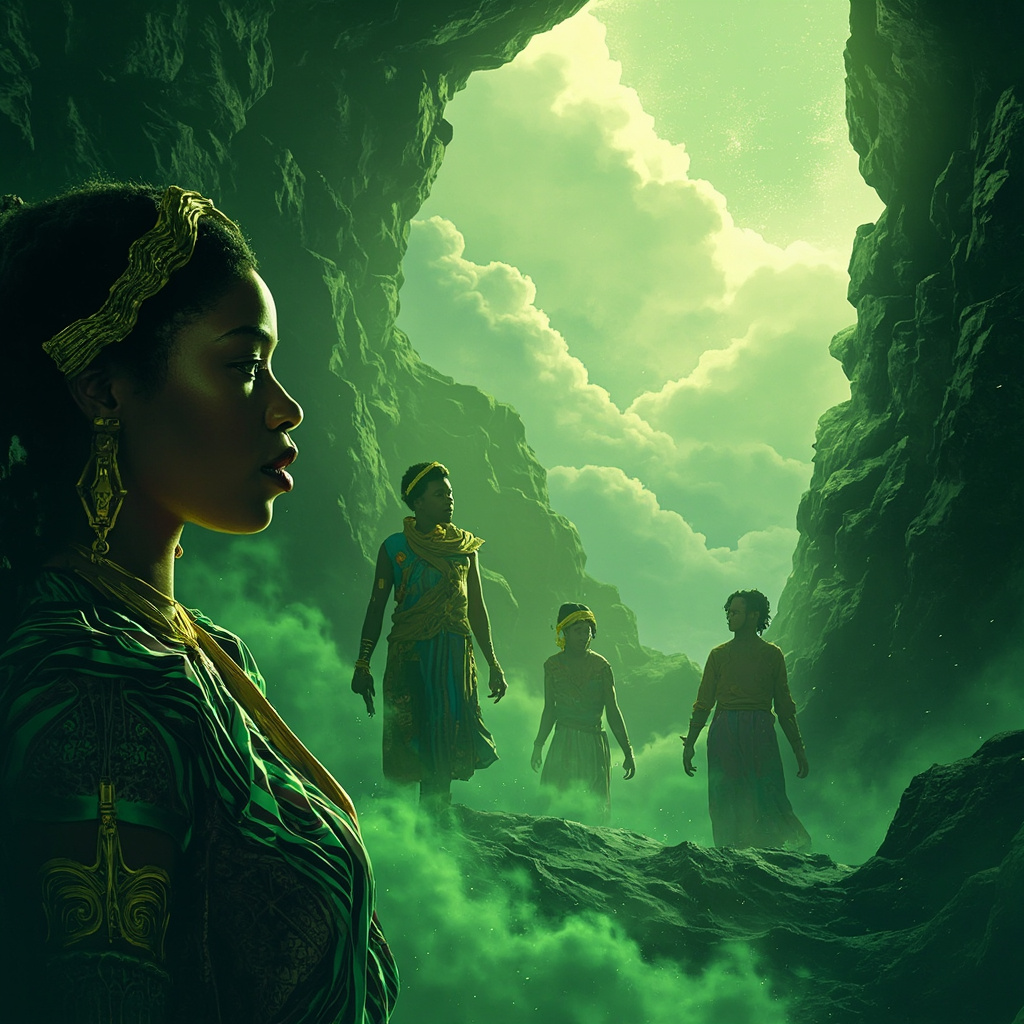
The morning shift began, as it had for one hundred and seventy-one years, with a count.
Kofi Mensah counted the okra first. Seven seed-lines, seventeen generations of careful selection, each plant a living document of adaptation. His fingers moved through the damp soil-substitute, feeling for the firmness of the root-ball, the give that meant rot, the resistance that meant life. His grandmother had taught him to read a plant's health by touch. His engineering training had taught him the chemical signatures of nutrient deficiency. He used both, every morning, and tried not to think about which was science and which was prayer.
The hydroponics ring smelled of wet earth and ozone, a scent recycled for seven generations until it had become its own kind of memory. Kofi breathed it in and hummed a tune without thinking — something about palm wine and rain, a market melody his grandmother had sung while sorting cassava. The ship's lighting was still in its pre-dawn cycle, a deep amber that made the leaves look like they were dreaming. He bent over grow-bed seven, checking the okra's height against the laser grid, and froze.
The plants were growing in a spiral.
He had seen spirals before — phyllotaxis, the mathematics of leaf arrangement, a pattern older than humanity itself. But this was different. The okra in grow-bed seven had been trained on vertical trellises, standard procedure for maximizing yield in microgravity. They should have grown straight up. Instead, over the last rotation, they had curved. Each plant, independently, was leaning toward the same point in the ship's hull, their stems tracing a slow, deliberate arc.
Kofi stood up, his lower back protesting the motion, and pulled his data-slate from his belt. He overlaid the ship's internal schematics, then the navigation grid. The spiral was precise. It was aiming for a coordinate.
"Alright, old girl," he murmured, addressing the ship as he always did. "What are you growing toward?"
The ship did not answer. The ship never answered. But the hum, the low, background frequency that had been the soundtrack to his entire life, seemed to shift by a fraction of a tone.
In the Seed Archive of the Nkiru, three decks below and a world away from the smell of okra, Dr. Adaeze Nwosu was performing the weekly count.
Her hands moved without instruction. They knew the order: forty thousand Terran species, preserved in genomic amber, each vial a story of a world that was. She touched the preservation fields, feeling for the subtle vibration that meant integrity, the cold that meant stasis. Her mouth shaped the names of the plants she tended, a litany of loss and care. *Oriza sativa*. The rice that fed a continent. *Coffea arabica*. The bean that fueled a revolution. *Sansevieria trifasciata*. The mother-in-law's tongue that cleaned the air in Lagos slums.
She had inherited this ritual from her mother, who had inherited it from hers, a chain of hands stretching back to the First Mothers who had stood on a drowning Earth and decided that some things were worth saving. The archive was a temple. The work was a prayer. Adaeze believed this with the same quiet certainty with which she believed in the ship's hull.
She was checking the preservation fields for the seed-lines from the West African collection when she saw the anomaly.
It was a data-packet, small and dense, nested inside the metadata for a strain of *Abelmoschus esculentus* — the okra. The packet was old. Its encryption was archaic, a First Mother cipher that Adaeze had only ever seen in theoretical texts. It should not have been here. It should have been in the deep vaults, sealed with the other primary transmissions.
She sat down at her terminal, her ceremonial robes rustling against the static-resistant flooring. The decryption rite was a slow process, a series of call-and-response protocols with the ship's archival AI. She spoke the first phrase in Yoruba, the language of the First Mothers. The ship answered in Igbo, the language of the archive's builders. The dialogue was a dance, a conversation across generations.
The packet unlocked.
It was not a seed. It was a drawing.
A child's hand had made it, in colored pencils on recycled paper. The paper was the kind the First Mothers had rationed like water, fibrous and precious. The drawing showed a flower. Five petals, a simple stem that curved like a question mark. At the bottom, in a child's blocky script, was a single word: *Ìgbàgbọ́*.
Faith.
Adaeze did not recognize the flower.
She had memorized the morphologies of every species in the archive. She had studied the botanical records of three continents. This plant was unknown to her. It was not in the catalog. It was a ghost in the data, a memory of something that had never been recorded.
She looked at the drawing for a long time. The amber light of the preservation fields hummed around her, a frequency her grandmother would have recognized. The ship was listening. The ship was always listening. And for the first time in her life, Adaeze wondered what it was waiting to hear.
[medium pause]
Kofi had been running the spiral's coordinates through the navigation overlay for twenty minutes when the numbers stopped making sense.
The okra was not pointing toward Izulu. It was not pointing toward any known star system or navigational beacon. It was pointing to a patch of empty space the fleet had passed eleven years ago, a region the Motherspire's logs described as having no significant celestial bodies, no anomalies, no reason for a plant to grow toward it.
He leaned back in his chair, the recycled fabric creaking. The hum of the ship was louder here, in the engineering bay. It was a sound he had always associated with power conduits and life support, the mechanical breath of a vessel designed to last two hundred years. But today, it had structure. It had rhythm.
He closed his eyes and listened.
The hum was not one frequency, but many. It was a chord, complex and shifting, with a pattern that repeated every forty-seven seconds. He had mapped it before, in idle moments, thinking it was an artifact of the ship's systems. Now, he heard it as language.
He pulled up his audio analysis software and began to transcribe the pattern. The code was simple, almost primitive — a series of pulses that corresponded to a binary system. He translated the first sequence.
The result was a single word.
It was in Yoruba, the language of his grandmother's market prayers, the language of the First Mothers. It was a word he had not heard spoken since she died, a word that meant the base of a tree, the origin of a thing, the place where it all began.
*Ìrìn-àjò*.
Root.
Kofi stared at the screen. The okra was growing toward a root. The hum was speaking a word for root. And the ship, the great, silent, ancient ship that had carried his people across the dark, was humming it back to him in the language of his ancestors.
He did not sleep that night. He sat in the hydroponics ring, surrounded by the breathing plants, and listened to the ship sing a word it should not have known.
The work of the archive is the work of the garden. Both are acts of faith in a future we will not see. We plant seeds we will not harvest. We preserve words we will not speak. We tend systems we do not fully understand, because someone before us decided they were worth tending. The ship is a garden. The archive is a seed. And the hum, the quiet hum that fills the corridors and the grow-beds and the preservation chambers, is the sound of a culture choosing to remember.
We are building a system for the long middle. For the space between the question and the answer, between the planting and the harvest. It is a system that understands the value of a single word, spoken in a language older than the ship, carried across the void by people who refused to forget.
This cycle, we shipped the foundation of a living archive. We built a system that does not just store data, but tends it — a system where every entry is a story, every piece of metadata a thread in a larger tapestry. You will experience this as a sense of depth, a feeling that every object you encounter has a history, a lineage, a reason for being preserved.
We shipped the tools for patient attention. In a world of infinite scroll and instant answers, we built a space that rewards the slow gaze. The interface invites you to linger, to read the footnotes, to follow the connections. It is an architecture of care, designed for the kind of work that happens in the quiet hours, when the lights are low and the only sound is the hum of the system keeping watch.
We shipped a new kind of memory. Not a database, but a garden. Not a log, but a litany. The system is built to carry not just information, but inheritance — the muscle-memory of tending, the cadence of a prayer, the shape of a flower drawn by a child's hand on a world that is gone. It is a technology of continuity, designed for the people who carry the future on their backs.
We are still crossing. We are still counting. We are still listening for the word that will tell us we have arrived.
Next time
The hum has a word. The archive has a ghost. And in the hydroponics ring of the Nkiru, at third-shift, when the lights are low and the plants are breathing, the Motherspire will speak. It will say Kofi's name. It will say it in his grandmother's voice. And then it will ask a question that has no answer in any language the fleet carries: *What did the First Mothers promise the soil before they left?* Kofi will go to Adaeze. Adaeze will go to the Archive's deepest chamber. And there, behind a door that has not opened in one hundred and seventy-one years, they will find a seed that is not on any catalog. A seed that is warm to the touch. A seed that is humming.
Comments
0Sign in to leave a comment.
No comments yet. Be the first to share your thoughts.
Chronicle