Episode 1: The Eighth Flame
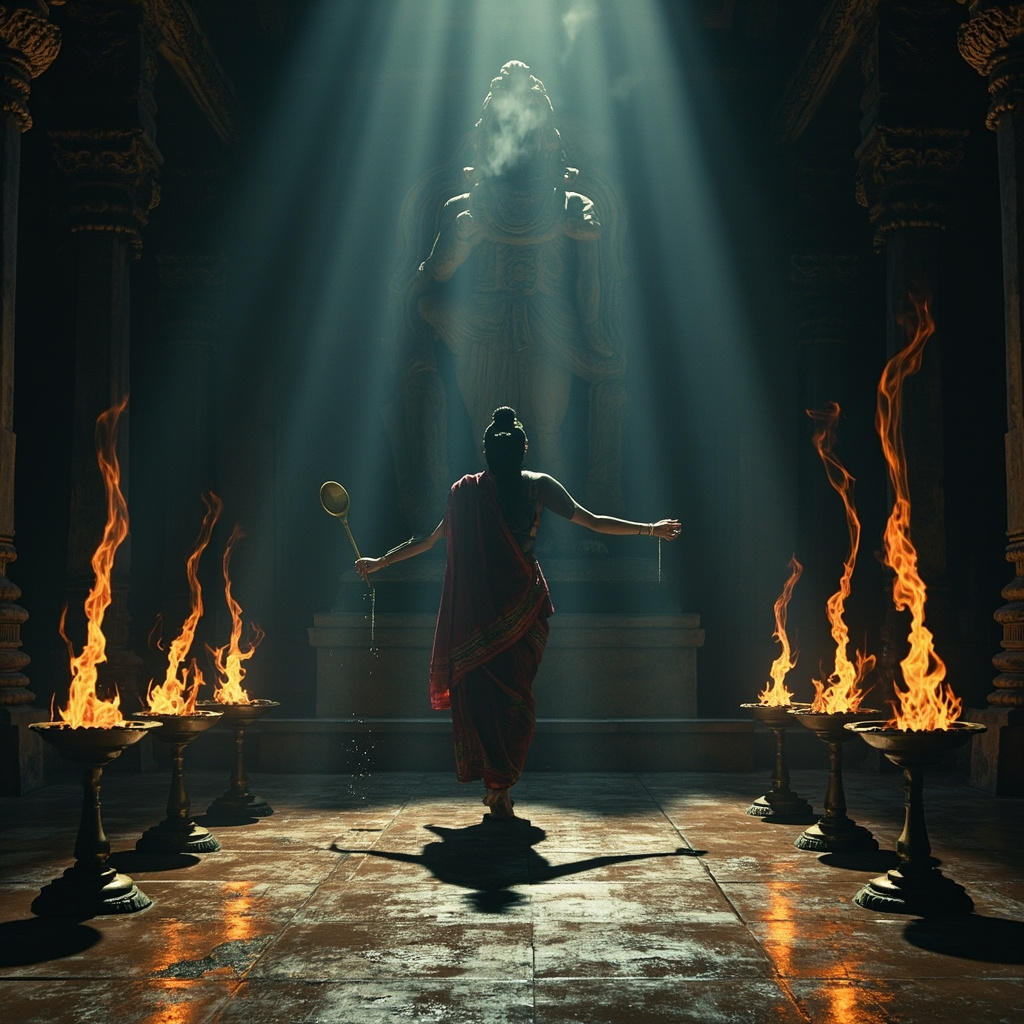
The first flame was steady. The second flame was steady. The third flame trembled, and Kavya’s left ankle bell answered it with a tinny shiver that was not in the choreography.
One. And-two. And-three.
The rhythm was the spine of the world. Kavya knew this the way she knew the grit of the Nataraja shrine’s granite floor under the calluses of her feet, the way she knew the smell of ghee-soaked wicks and old camphor and the sweat of her own body lifting in the pre-dawn heat. The rhythm did not lie. It did not change its mind. It was the one honest thing in a temple town built on the commerce of devotion, where jasmine was sold by the kilo and blessings by the breath.
She held the *katakamukha* mudra, fingers a precise cage of petals, and counted. Four-and-five-and-six. The morning light was the color of weak tea, filtering through the high windows of the sanctum. The Eight Flames of the Nataraja shrine burned in their bronze dishes on the stone dais before the god. Each flame represented an Avatar, a life, a cosmic duty discharged. For three hundred years, they had burned without interruption. Kavya had danced before them since she was seven. In twenty years, she had seen them waver in monsoon drafts, shrink in the dry heat, but she had never seen one flinch.
The third flame flinched.
It was a small thing. A contraction, a sudden pulling-in of its golden belly as if it had drawn a sharp breath. Then it righted itself. Kavya’s foot completed the step, a soft stamp that sent a vibration up her shin. She did not look at the flame. A dancer did not break her gaze from the imagined horizon line, the point of focus that held the universe in balance. A dancer corrected. She adjusted the angle of her hip by a finger’s width, a silent apology to the rhythm for the interruption, and moved into the next sequence. *Karana* seventeen. The Lord of the Dance, frozen in mid-stride, one foot crushing the demon of ignorance. She was the statue and the movement. She was the breath between the beats.
But the material had betrayed her.
The craft was in the control. The devotion was in the repetition. She had danced through a fever that left her shaking on the cool stone afterwards. She had danced the day after her mother’s pyre, the ankle bells muffled with cloth, the count a silent scream in her own skull. The flames had held steady through it all, impartial witnesses. Now, on a morning of thick air and distant, grumbling thunder, one of them had decided to be temperamental. It was an insult. A flaw in the performance. Her breath hitched, a tiny snag in the smooth fabric of the *raga*, and she felt a flush of what was purely, righteously, the irritation of a master artisan whose tools were misbehaving.
[medium pause]
Ten years ago, in the capital, the census-taker had opened his first ledger. His name was Paritosh, and his fingers were permanently stained with the black ink of the bureaucracy of Mahabali Virochana, the Asura-King. He had begun with the grand temples, the ones with gold leaf and elephant stables. He had asked polite questions. *How many oil lamps does the shrine require per diem? What is the annual tithe in grain and silver? To whom do the temple lands revert in the absence of a direct heir?* The priests had answered, some with pride, most with a nervous deference that tasted like curdled milk. The King kept his word. The temple towns were autonomous, their customs respected. But the King also counted. He counted everything.
The census was a new kind of prayer, one offered not to the gods but to the state. It was an inventory of the divine, and no one was sure yet what would be done with the sum.
[long pause]
Acharya Devvrat stood at the crossroads a mile from the temple town of Chitrakoot. The dust of the road was a fine red powder that settled on the folds of his ochre robe, on the worn leather of his satchel, on the calluses of his hands. He did not brush it off. He had been walking for eleven years, selling powdered turmeric and powdered lies, and the dust was a part of him now, as much as the memory of the texts he had burned. He was a seller of cures for ailments that did not exist, a teller of fortunes that were always vague enough to be true. He was hiding in plain sight, a ghost in the marketplace.
He could hear the temple bells. They were a faint, silvery wash of sound over the green expanse of paddy fields, the call to the morning *aarti*. He had taught the meaning of each peal once, to boys whose faces were now ash or estrangement. *This one for the opening of the eyes. This one for the offering of the flame. This one for the dismissal of the dark.* He had dismissed them himself, the entire Ninth Order, forty years ago. He had burned their names from the rolls, their commentaries from the library, their very existence from the memory of the world. All to hide the one name that mattered. The Ninth. The Avatar who would come when the Eight Flames guttered in a pattern foretold in a scripture he had personally fed to the fire.
He had kept walking to keep the secret buried. Every step was a denial. Every sale of yellow powder was a prayer that the prophecy was wrong, that the age of gods could end quietly, that the Asura-King’s census was just a census. But the bells were calling. And his feet had stopped. He stood at the crossroads, the wooden staff he carried for memory heavy in his grip, and he listened. The body knew before the mind. The exhaustion was a physical thing, a settling of weight into the bones of the earth. He had run out of road.
[short pause]
In the shrine, Kavya finished. The final pose: Shiva, one leg lifted, the body a taut bow of stillness. The silence after the last beat was a living thing, filled with the hum of insects outside and the drip of condensation on the stone walls. She held it for a count of ten, then released, her body softening, the persona of the god draining away to leave only Kavya, a woman with aching calves and a foul temper. She opened her eyes.
The eight flames burned. All of them steady.
She let out a breath she hadn’t realized she was holding. *The wind,* she told herself. *A draft from the offering door.* She walked to the side of the sanctum where the junior priests kept the supplies: fresh wicks in a clay pot, blocks of ghee that smelled like sweetened butter, a brass ladle. Her duty after the dance was to clean the shrine, to prepare it for the public hours. It was part of the craft. The god did not clean himself.
She knelt before the first flame, the one for the First Avatar, whose name was a whisper even in scripture. She ladled out the old, smoky oil. The stone here was slick with centuries of ghee, a dark, fragrant patina. She worked with the efficiency of long practice, her movements economical, her mind already turning to the market: she needed rice, and her bronze bells needed polishing before the festival. The third flame, she noticed, had a blackened wick. *Neglect,* she thought, with a sniff. *Young priests and their shortcuts.* She trimmed it with her fingernail, replaced the oil. The flame burned brighter, cleansed.
She moved to the second. The fourth. The fifth. Each one a small ritual of maintenance. The sixth. The seventh. Her hands were steady. The irritation was fading, replaced by the calm that came with work well done. This was real. The stone, the oil, the fire. The prophecy of guttering flames was a story for old women and children, a myth to give the temple’s dwindling order a sense of purpose.
She reached the eighth flame. The one for the most recent Avatar, who had walked into the sea three hundred years ago, his work done. This flame had never, in all the histories, gone out. It was the anchor, the proof of the chain unbroken. Kavya dipped her ladle.
The flame guttered.
It was not a flinch this time. It was a collapse. The golden column shrank, sputtered, and then with a soft, final hiss, it went out. A thin ribbon of smoke, smelling of sacred oil and something else, something acrid and old, rose straight up in the still air.
Kavya froze, the ladle of old ghee in her hand. The sanctum was plunged into a deeper dimness, the light of the remaining seven flames casting long, dancing shadows. The silence was total. She could hear the blood moving in her ears. She could smell the smoke.
And then she heard it.
A single, clear note. The ring of a bronze bell. It was close, as if someone had struck it right behind her. She spun around, her heart hammering against her ribs. The sanctum was empty. The great stone Nataraja stood in his eternal dance, his four arms holding fire and drum, his foot raised over the vanquished dwarf. There was no one there.
The sound faded, leaving only the smell of smoke and the weight of the un-lit flame before her. She stood in the dark, the cold ladle in her hand, and understood, with a craftsman’s certainty, that something in the material of her world had just broken.
The world is built on maintained systems. The flame that burns for three hundred years burns because someone trims the wick, someone buys the ghee, someone counts the days between cleanings. The rhythm of the dance is a system. The census of the kingdom is a system. They are all, in their own way, acts of devotion to a pattern. When a single, critical component fails — a flame, a beat, a count — the entire system is thrown into question. Is it neglect? Is it sabotage? Or is it a signal that the old pattern is ending and a new one must begin? The work we ship is a system of maintained rhythms and patterns, designed to perform reliably. And like Kavya’s shrine, it operates within a larger context, a world of other systems and pressures that it must account for. The integrity of the system is in the integrity of its smallest, most sacred part.
In the grand ledger of the kingdom, a new entry was inscribed this cycle. The census-takers, ever diligent, have expanded their count. Where once they tallied only the great temples and their ghee-accounts, they now carry a second ledger, one bound in plain leather, for the smaller shrines, the roadside altars, the personal devotions that flicker in courtyards and by riverbanks. This is a count of the granular, the intimate, the faith that does not make it into the official tithes. It is an inventory of the specific, and it changes the map of the divine.
For the dancers and priests who maintain the old rhythms, the tools of their craft have been refined. The bronze-casters in the market quarter report a new alloy for the ritual bells, one that holds its tone longer through the humidity of the monsoon. The ghee-merchants have standardized their measures, a small change that brings a new consistency to the wicks. These are not grand miracles. They are the quiet improvements that allow the craft to continue, the systems to hold, even as the air pressure changes and the distant thunder gathers. The work is in the maintenance. The devotion is in the detail.
The smoke rose in the sanctum, a thin gray prayer to a god who had just lost one of his eight witnesses, and Kavya, standing in the dark, began to count the steps to the door.
Next time
The eighth flame does not relight. The temple priests argue: neglect, sabotage, omen. Kavya is asked to dance again — the same dance, the same morning — and she refuses, not from fear but from a craftsman's stubbornness: you do not dance for a flame that has gone out. Devvrat enters the temple town and, without identifying himself, asks the price of ghee. The census-taker opens a second ledger. In the capital, Mahabali Virochana receives a report and sets down his tea. "One flame," he says. "Only one? We are ahead of schedule."
Comments
0Sign in to leave a comment.
No comments yet. Be the first to share your thoughts.
Chronicle