Episode 1: The Orphan Commodity
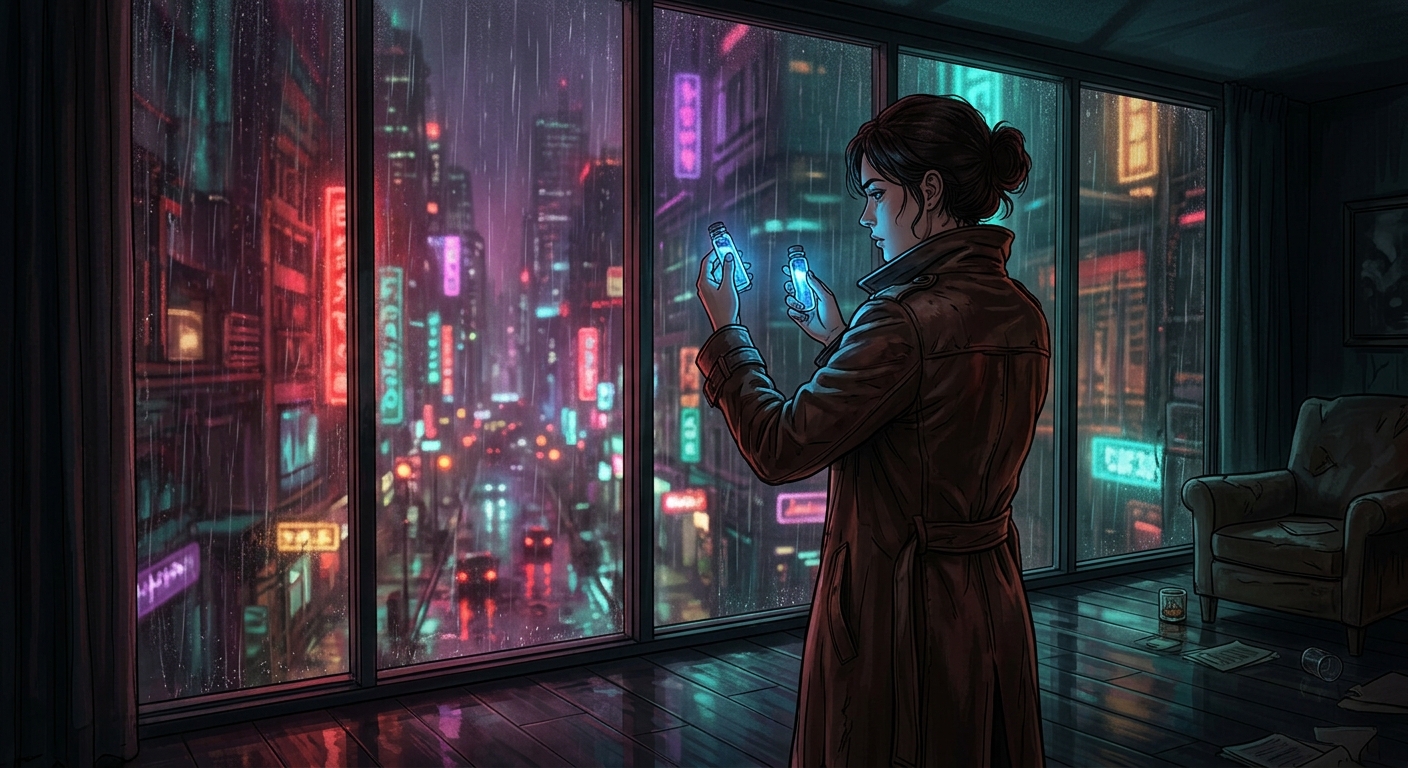
A first kiss sold for forty on the Meridian Exchange that Tuesday. A standard package: the scent of cheap gin, the scrape of a brick wall against a shoulder blade, the taste of salt and someone else’s lipstick. Forty credits bought you the whole three-second loop, certified and bottled, the kind of memory that kept the lights on in the Flood District. It was a buyer’s market for sentiment. Everything was a buyer’s market in the rain.
The rain in Port Meridian had weight. It fell like a debt, accumulating on the slate roofs and the shoulders of coats until the whole city felt like it was sinking under a ledger of unpaid dues. Cassandra Delacroix stood under the awning of a noodle shop, the neon sign above her bleeding red into the wet pavement. The sign read: *Yesterday’s Soup*. It was a front. All the best places were.
She was here for the commodity, the raw material. Not the sanitized packages on the Exchange, certified and stamped with a broker’s seal. She wanted the uncut stuff. The orphans.
The entrance was a door in the alley, the wood so swollen with damp it groaned when she pushed it open. The air inside was thick with the smell of ozone from cheap, unregulated vials and the savory steam of pho from the shop above. A child with eyes like old glass sat on a stool, a wax tablet in his lap. He didn't look up. He didn't need to. He recorded every transaction that came through the door on the tablet, then wiped it clean with the heel of his hand at the end of the night. He had no memory of yesterday. He was the market’s perfect accountant.
Cass descended the stairs. The basement was a maze of plywood stalls, each one lit by a single, bare bulb that hummed with a sickly yellow light. Vials glittered on velvet cloths like jewels in a dragon’s hoard. The brokers here didn’t wear suits. They wore desperation and waterproof jackets.
“Delacroix.” A voice, slick as oil on water, came from the first stall. It belonged to a man named Silas, whose face was a roadmap of bad deals. “Looking for something specific? I got a governor’s resignation. Authentic. The shame alone is worth a hundred.”
“I’m not buying guilt today, Silas. I’m browsing.”
She moved through the narrow aisles. The memories on offer were common stock. A childhood pet, a graduation, the bitter tang of a lost argument. The prices were marked in chalk on small blackboards. Cass ran her fingers along the vials, feeling the faint hum of the stored recollections. Most were warm to the touch, a low-grade fever of lived experience. She was looking for something cold.
She found it three stalls from the back, in the shadow of a dripping pipe. The stall was run by a woman with a tremor in her hands and a price board that was mostly erased. The vials here were junk. Fever dreams, fragmented sensory data, the memory of a headache. And one other.
It sat apart from the others, on a square of black cloth. The vial was plain glass, no manufacturer’s mark. The liquid inside was clear, but it seemed to hold the light differently, to absorb it rather than reflect it. It was cold. Colder than the basement air, colder than the rain outside. It felt like holding a sliver of deep space.
Cass picked it up. The price tag, written in a shaky hand, read: 40.
Forty credits. For what? She held it up to the weak light. The memory was short, a single, unbroken shot. A city. The architecture was all wrong—towers of spun glass and bridges of light that hung in the air with no visible support. Streets that seemed to rearrange themselves as she watched, a labyrinth that was also a living thing. The perspective was from a high balcony, looking down. There was no sound, no people. Just the silent, impossible city.
She checked the date stamp etched into the wax seal at the base of the vial. Her breath caught, a small, sharp thing in her throat. The date was three hundred years from now.
“Forty?” Cass said, her voice flat. “This is mispriced.”
The woman with the tremor shrugged, not meeting her eyes. “Orphan. Belongs to nobody. Can’t verify the provenance, can’t guarantee the source. It’s a phantom. You want it or not?”
Cass looked at the vial again. A phantom. A recollection that had no owner, no origin, no place in the chain of custody that kept the memory market from collapsing into chaos. It was a ghost in the machine, a piece of data that shouldn't exist. The price wasn’t a bargain; it was a disposal fee. The seller wanted it gone.
She should have walked away. Orphan data was a liability. It could be corrupted, a trap left by a rival broker, a memory-virus that could overwrite your own recollections with junk code. But the city in the vial… it was too specific, too detailed to be a glitch. A glitch was static. This was a blueprint.
“I’ll take it.”
She paid in credits, the transfer a silent flicker from her wrist-implant to the woman’s. The vial felt heavy in her palm, a weight disproportionate to its size. She slipped it into the inner pocket of her coat, where it rested against her ribs like a cold, hard secret. The cost of curiosity. She paid it without a second thought. That was the first mistake.
[medium pause]
Two hours later, the rain had settled into a miserable, persistent drizzle. Cass was in her apartment, a sterile space high in the Spire District where the rain sounded different, less like a debt and more like a distant memory of one. The orphan vial sat on her desk, next to a cup of black coffee that had gone cold. She’d run it through her private analyzer twice. The results were the same. No origin stamp. No decay signature. The memory was pristine, as if it had been bottled yesterday. But the date stamp was clear. It was from the future. A future that did not exist.
Her comm chimed. A restricted number. She answered.
“Delacroix.”
“Vasquez.” The voice was clipped, all business. Detective Elena Vasquez, Memory Crimes Division. They’d crossed paths before. Vasquez was a bloodhound who trusted evidence and hated anomalies. Anomalies made her job harder. “I’m downstairs. I need a consult.”
“On what?”
“On a piece of impossible evidence. Open the door.”
Vasquez was wet. She stood in Cass’s doorway, water dripping from the hem of her long coat onto the polished floor. She didn’t seem to notice or care. Her face was sharp, her eyes tired. She held up an evidence bag. Inside was a memory vial.
“You broker memories,” Vasquez said. It was an accusation. “I need to know what this one is.”
She didn’t explain. She never did, not at first. She liked to watch your face when you saw the thing itself. Cass took the bag. The vial inside was identical to the one on her desk. Same plain glass, same strange, light-absorbing quality. Same cold.
“Where did you get this?” Cass asked, her voice carefully neutral.
“From a dead man. Fished out of the harbor this morning. No ID. No wallet. No implants. His entire memory core was wiped. Scoured clean. Except for this.” Vasquez nodded toward the vial. “It was the only thing left in his head. Over and over, on a loop. The M.E. said it was like a skipping record, playing the same three seconds until the hardware burned out.”
Cass held the evidence bag up to the light from her window. She could see the memory inside. A city. Spun-glass towers, light-bridges, streets that moved. She walked to her desk and picked up the orphan vial, holding them side-by-side.
They were identical. The same city. The same angle. The same impossible, silent future. The same date stamp, three hundred years out.
“It’s the same city,” Cass said.
“The man it belonged to had no other memories,” Vasquez said, her voice low. “Just this. Over and over. He died with a picture of a place that doesn’t exist burned into his brain.”
Cass looked at the two vials. One from the black market, priced to be forgotten. One from a corpse, a dead man’s only legacy. The same future, twice. A coincidence was a story you told yourself to keep from looking closer. This was a pattern.
“How much did you pay for yours?” Vasquez asked.
“Forty.”
Vasquez let out a short, humorless breath. “Mine was free. Came with the body.”
They stood in silence for a long moment, the only sound the hum of the building’s climate control and the distant, endless rain. The city outside was a wash of gray and neon. The city in the vials was a ghost of a promise, a blueprint for an endgame no one had been invited to. The question hung in the air between them, unspoken, heavy as the debt of rain on the city below: How many more were there?
[long pause]
That night, after Vasquez had gone, leaving the dead man’s vial in Cass’s care for analysis, Cass made a call. She used the old line, the secure one that ran through the Exchange’s pneumatic tubes, a direct connection to the vault beneath the old lighthouse. The phone rang once, twice. A click. A low hum.
“Archivist.” The voice was calm, measured, each word weighed and catalogued. He had not left that vault in eleven years. His world was the Exchange, its history, its inventory. He was the city’s memory.
“I have a query on provenance,” Cass said. “An orphan vial. No origin stamp. Date stamp is… anomalous.”
“Anomalous how?”
“Three hundred years forward. It contains a city. Not ours.”
The silence on the line was absolute. It was a silence that contained entire ledgers of information. When the Archivist spoke again, his voice was exactly the same, but the quality of the silence around it had changed. It was heavier.
“The memory,” he said. “It has no origin stamp. No owner. No decay signature. It is, by every metric we use, impossible.”
He did not say he had seen it before. He did not say anything else.
The line went dead. The click of the receiver was as final as a gavel. Cass stood in her silent apartment, the two vials on her desk catching the city’s neon glow. The Archivist had not answered her question. He had confirmed her fear. The impossible was in the inventory.
The market is the system. Every memory has a price, a provenance, a place in the chain. But what happens when a piece of data enters the system that has no origin? When a commodity appears that cannot be accounted for? The system does not know how to price it. It becomes a ghost in the ledger, a piece of information that destabilizes the entire market. This is the challenge of the new: it arrives without a manual, without a history, without a price. The only choice is to ignore it, or to try and understand it. To understand it is to risk everything.
This cycle, the Exchange has processed a new class of asset. We are calling it the Orphan Commodity. It appears on the ledgers without origin, without a chain of custody, and with a value that defies current market models. The first two instances have been logged. The initial acquisition was made on the open market for a nominal fee, indicating the seller’s desire to offload a volatile, unverifiable asset. The second was acquired as part of a forensic inventory, a piece of evidence with no other context.
Our analysis indicates these commodities are not glitches. They are coherent, data-dense, and temporally stamped in a way that breaks our current verification protocols. They are, for lack of a better term, assets from a future market we have no record of. The Exchange is now running a full diagnostic on its archives. We are cross-referencing every transaction from the last century, looking for other anomalies, other ghosts in the ledger. We advise all brokers to exercise extreme caution with any memory that lacks a verifiable origin stamp. The value of curiosity is rising. The cost may be higher.
The rain fell on Port Meridian, washing the neon down the gutters in slick, colorful rivers. In her apartment, Cass sealed the two vials in a lead-lined case. The city in the glass was silent and waiting. The price of looking was now the price of knowing. And the debt was just beginning to come due.
Next time
**Story:** Cass takes the two vials to the Exchange. The Archivist examines them in silence, then says something he has not said in twenty years: “I have seen this city before.” He shows her a third vial — older, cracked, the memory inside faded but unmistakable. Same streets. Same date. Same impossible future. He tells her it was found in the foundation of the old lighthouse, sealed in a wall that was built before Port Meridian had walls. He does not tell her who put it there. He does not tell her why he kept it. The episode ends with Cass asking the only question that matters: “How many of these are there?” The Archivist looks at her with the expression of a man who has been counting for a very long time. **Product:** The system is expanding its search. New filters are being deployed to detect assets with non-standard temporal signatures. The goal is to create a complete registry of all Orphan Commodities. We are building a map of the impossible. The first draft will be available to Tier-One brokers next cycle.
Comments
0Sign in to leave a comment.
No comments yet. Be the first to share your thoughts.
Chronicle