Episode 1: The Inventory of Silence
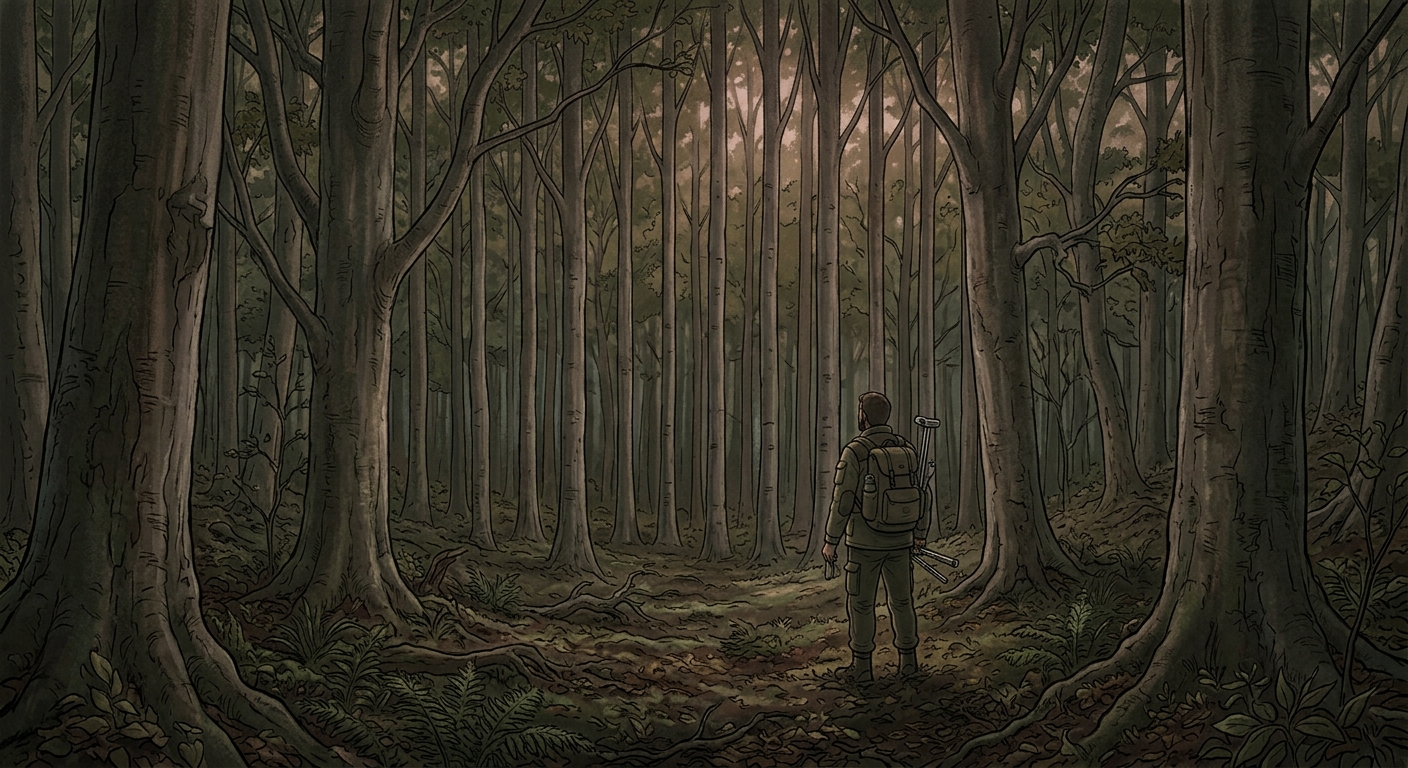
The resin smelled of turpentine and old churches. Hamza Belkacem noticed this every morning for the first hour of his patrol, and then he stopped noticing, which was a thing he had been trained to file as a sign of acclimatization.
The spruce plantations of the northern slopes were an inventory of straight lines. He walked them with his GPS unit in his left hand, the antenna angled forty-five degrees from vertical, a posture his predecessor had taught him in a single afternoon of silence and gestures. The unit logged his position every thirty seconds. It drew a green line on the screen behind him, a thread unspooling through a forest that had been measured so many times it should have held no surprises. The 1987 survey. The 2003 survey. The satellite overlay from last March, which he had printed and folded into the pocket of his field vest, the creases already soft with humidity. The forest was a grid of management compartments, each one numbered, each one with a history of planting and harvesting that went back to the post-war replanting campaigns, and further, to the private estates of the nineteenth century, and further still, to the commons that the Revolution had carved from the monastic lands. He knew this the way a man knows the streets of a city he did not choose. The knowledge was administrative. It kept the world at a remove.
The radio on his hip made a sound like a clearing throat and then was silent. The dispatcher in Munster would not call unless there was a fire or a body. He preferred it that way. He had come here from Strasbourg, from a desk where his job had been to enter numbers into a system that converted them into other numbers, and from which he had been removed after a conversation he remembered as a series of closed doors and a woman in human resources who would not look at him. The posting in the Hautes-Vosges was described in the transfer documents as *isolement modéré*. Moderate isolation. He had found this to be accurate. The isolation was moderate. The silence was not.
He reached the edge of Compartment 14B and stopped. The GPS showed him as a small triangle on a screen of pale green. Ahead, the managed spruce gave way to a stand of beeches. This was the reserve forest, the old growth that had been set aside in the 1970s, a pocket of something the forestry commission called *sylve primaire*, though everyone knew it had been logged at least once, probably in the seventeenth century, probably for the charcoal burners who had left their mounds like sleeping animals all through the lower slopes. The beeches were tall. Their canopies formed a ceiling. The light beneath them was the color of watered-down wine. He had been here three times before. He had counted the trees. He had measured their girth at breast height, a standard procedure for the reserve inventory. He had noted their positions on his tablet, using the forestry commission's mapping application, which was precise to within one meter.
[medium pause]
The numbers had been wrong.
He had not filed this as a report. He had filed it as a *note*, which was a different category in the system, a category for observations that did not meet the threshold of an anomaly but which the observer wished to record for the sake of completeness. The note read: *Stand at grid reference 48.0713°N, 7.0142°E. Beech (Fagus sylvatica). Approx. 40-60 stems. Not present on survey 1987, survey 2003, or satellite overlay 2024-03. Possible survey error. Recommande verification sur place.* He had sent it to his supervisor in Colmar. He had received an automated reply confirming receipt. He had heard nothing since. This, too, was a form of silence.
He walked into the beech stand. The ground changed. The needle-strewn floor of the spruce plantation gave way to a carpet of leaf mold, black and crumbling, the kind of soil that smelled of time itself, of things that had fallen and been forgotten and had become the ground on which other things stood. He took a reading. He took another. He counted the trees, moving from the southern edge of the stand inward, touching each trunk with his hand, a habit he had developed, though he could not have said why. The bark was smooth. Beech bark was supposed to be smooth, silver-grey, sometimes scarred with the dark lichens that grew in the crevices. This bark was smoother. He noted this. He noted that the trees were spaced with a regularity that did not occur in natural regeneration. He noted that their girths were uniform, all within a range of ten centimeters, as if they had been planted, though there was no record of planting and the soil showed no sign of the plowing or mounding that a planting crew would have left. He noted that the stand was oriented along an axis he could not immediately correlate with the slope, the prevailing wind, or the aspect of the sun. He filed these notes in his head. He would write them down later, in the evening, in the small apartment above the garage in the village, where the only sound was the hum of the refrigerator and the occasional car on the road below. The notes would join the other notes. They would form a record of a thing he did not understand. The record would be precise. Precision was a form of prayer, though he would not have used that word.
[long pause]
The Priory of Sainte-Marie-des-Bois stood at the end of a road that was not on the tourist maps. The road was paved, after a fashion, with stones that had been laid so long ago they had sunk into the earth and become a part of it, their edges rounded by centuries of rain and the slow grinding of cartwheels and, later, the tires of the single delivery truck that came once a week from Munster with supplies. Thérèse Morin heard the truck before she saw it. She heard it the way she heard everything: as a sound with a weight and a texture, a sound that had a place in the order of the day, a sound that belonged to a particular hour and a particular quality of light. The truck came on Tuesdays, at half past ten, when the sun had dried the dew on the garden paths and the shadows of the beech trees had retreated to the base of the priory wall. The sound of the truck was a low grinding, a complaint of gears, a hiss of brakes. It was a sound that meant the world outside still existed, that it was still grinding on, that it had not yet stopped.
She did not go to meet the truck. Sister Agathe had met the truck, and before her, Sister Marie-Cécile, and before her, the long line of sisters who had met the truck or the cart or the man with the mule, all the way back to the thirteenth century, when the priory was founded by a group of women who had chosen this valley because it was remote and because the bishop of Strasbourg had given them the land and because there was water and because the forest was a wall against the world. Thérèse was the last. She had been the last for two winters, since Sister Agathe had died in her sleep, her breath stopping between the third and fourth psalm of Vigils, a death so quiet it was almost a form of liturgy. Thérèse had found her in the morning, her hands folded on her chest, her face composed, the breviary still open on the stand beside her bed. Thérèse had rung the bell. She had rung it for the death, and then for the funeral, and then for the burial in the small cemetery where the stones were so old the names had been worn away, leaving only the shapes of letters, like the ghosts of words. She had rung it every day since, at the canonical hours, for no one. The bell was a voice she could trust. It said the same thing every time. It said: *This is the hour. You are here. The world continues.*
The garden was her other voice. It spoke in the language of things that grew and things that died and things that grew again. She knelt in the soil at the hour of Terce, her knees on the flat stone she had placed there forty years ago, when she was twenty and her grief was a new thing, a thing with a weight and a shape, a thing she could almost hold in her hands. The grief had changed over the years. It had become a part of the ground she knelt on, a part of the habit she wore, a part of the silence that was the medium in which she lived. She weeded the beds of lavender and thyme. She tied the climbing roses to the trellis. She harvested the beans when they were ready and the tomatoes when they were ripe and the herbs when they smelled the strongest, which was always in the heat of the day, when the sun was high and the shadows were short and the air was thick with the scent of growth. She did these things because they were the Rule. She did them because her hands remembered. She did them because the garden was a form of speech, and she had long since forgotten how to speak in any other way.
She had not spoken aloud in eleven days. She had not needed to. The bell did not require a voice. The garden did not require a voice. The prayers she said in her head, moving from one hour to the next, from Lauds to Prime to Terce to Sext to None to Vespers to Compline, did not require a voice. They were a current that ran beneath the surface of the day, a current that kept her oriented, that told her where she was in the vast and silent machinery of time. She had learned, over forty years, to live inside that current. She had learned to let it carry her. She had learned that silence was a form of attention, and that attention was a form of love, and that love was a form of listening.
[medium pause]
The hour of None came. The bell was in the cloister. She rose from the garden, her knees stiff, her back aching in the way it always ached at this hour, a dull and familiar pain that was a part of the day's architecture. She walked the stone path to the cloister, her sandals making no sound. The cloister was a square of light and shadow, the arches supported by columns of red sandstone, each one carved with a different leaf: oak, beech, maple, linden. The carvings were eight hundred years old. She touched them as she passed, a habit, a greeting, a way of saying *I am here* to the women who had touched them before her. The bell rope was hemp, thick and soft, worn smooth by the hands of generations of sisters. She took it in her hands. She pulled. The bell rang once, twice, three times, the sound rising into the air and spreading out over the garden and the priory and the forest beyond, a sound that was a call and an answer at the same time, a sound that said: *This is None. This is the hour when the light begins to change. This is the hour when the shadows lengthen. This is the hour.*
She let the sound die. She stood in the cloister, her hands still on the rope, and listened to the silence that followed. The silence was not empty. It was full of the things the bell had shaken loose: the distant sound of a bird, the creak of the old wood of the bell frame, the hum of insects in the cloister garden, the sigh of the wind in the beech trees that stood beyond the wall. The wind was from the west. It carried the smell of rain, though the sky was clear. It carried the smell of the forest, which was a smell of earth and resin and the slow decay of leaves. It carried, for a moment, the smell of the river. The Moselle. She knew that smell. She had not smelled it in years, but she knew it the way she knew the smell of her own skin, the way she knew the smell of the habit she wore, the way she knew the smell of the garden after rain. It was a smell of wet stone and cold water and the particular sweetness of a body that has been in the water for three days. She had smelled it once, in the summer of 1983, when they had pulled her brother from the river. She had smelled it and she had known, before they told her, before they wrapped the blanket around her shoulders, before they led her away from the water's edge. She had known.
The smell was gone. It had been there for a moment, a ghost of a smell, and then it was gone, and there was only the smell of the cloister, the smell of old stone and the lavender that grew in the cracks, and the smell of the forest, which was always there, which was the background to everything. She let go of the rope. She walked back to the garden. The sun was lower now. The shadows of the beech trees were longer, reaching across the lawn like fingers. She knelt again, on the flat stone, and took up her trowel. The soil was cool. It smelled of earth. It smelled of the things that had grown here and the things that had died here and the things that would grow here again. She worked. She did not think. She let her hands do the thinking, let them move among the roots and the stones and the small, blind creatures that lived in the dark. She worked until the light began to fail, until the shadows of the beech trees reached the wall of the priory, until the first stars began to appear in the sky above the forest.
[long pause]
The wind moved through the beech leaves above her. It was a sound she had heard ten thousand times, a sound that was a part of the garden's grammar, a sound that meant *wind* and *leaves* and *the turning of the earth*. She did not look up. She kept her eyes on the soil, on the small, pale root she had been freeing from a clod of earth. The wind moved again, and the leaves made their sound, a sound like a crowd of people whispering, a sound like the sea heard from a great distance. She had heard this sound all her life. She had heard it in the garden and she had heard it in the forest and she had heard it in the cloister, where the wind found its way through the arches and stirred the dust on the stone floor. She had heard it so many times it had become a form of silence, a sound so familiar it was no longer a sound at all, but a texture, a quality of the air, a way the world had of breathing.
The wind moved. The leaves made their sound. And inside the sound, there was a voice.
It was not a word. It was a shape, a cadence, a rise and fall that she knew the way she knew the smell of the river, the way she knew the weight of her brother's hand in hers when they were children, walking along the bank, looking for stones. The voice was inside the sound of the leaves. It was a part of the wind. It was a thing the wind had learned to carry. She did not look up. She kept her eyes on the soil. She felt the trowel in her hand, the cool metal, the rough wood of the handle. She felt the stone beneath her knees. She felt the weight of the habit on her shoulders. She felt the sun on her back, low and warm, the sun of late afternoon, the sun of None, the hour her brother had drowned. The voice spoke again. It was a sound like a word she could not quite hear, a word at the bottom of a well, a word spoken through water. It was a sound like her name.
She closed her eyes. The trowel slipped from her fingers and fell into the soil. She did not reach for it. She knelt there, in the garden of the last priory in the Vosges, and listened to the voice in the leaves. The voice spoke a single word. The word was clear. The word was a sound she had not heard in forty-one years. The word was a sound that meant *sister*. Then the voice was gone. The wind moved. The leaves made their ordinary sound. The garden was silent. The priory was silent. The forest was silent.
She opened her eyes. The beech tree nearest to her, the old one, the one with the trunk as thick as a man's body, had dropped a branch. The branch lay on the path beside her, a limb of green wood, unbroken, its leaves still fresh, its bark smooth and silver. It had not been there before. It was pointing toward the forest.
The forest is an inventory. A ranger walks the grid, counts the stems, measures the girth, files the report. The system is designed to hold the world in a pattern of numbers and coordinates. The numbers are precise. The coordinates are accurate. The system is a form of attention, a way of saying *this is here, this is known, this is accounted for*. And then there is a stand of trees that is not on the survey. A voice inside a sound. A branch that falls from a green tree for no reason the wind can explain. The system does not fail. The system holds. The report is filed. The note is made. The silence that follows is the sound of the world being larger than the inventory.
The ranger's log for this cycle is thin. The coordinates have been checked. The survey has been consulted. The satellite overlay has been examined under the magnifying glass of routine. The report reads: *Stand at grid reference 48.0713°N, 7.0142°E. Beech (Fagus sylvatica). Approx. 40-60 stems. Not present on survey 1987, survey 2003, or satellite overlay 2024-03. Possible survey error. Recommend verification on site.* The note is filed. The system acknowledges receipt. The silence that follows is a form of waiting.
The nun's journal for this cycle is a single entry, written in the margin of her breviary, in the small, precise hand she has used for forty years. The entry reads: *At None, the wind in the beeches. A voice I knew. A branch fallen for no reason. I have pressed it between the pages of the book. I do not know what it is a sign of. I do not know if it is a sign. I only know that the voice was his, and that the branch was green, and that it was pointing toward the forest.* The entry is dated. The date is today. The breviary is closed. The branch is inside, its leaves still fresh, its bark still smooth. The smell of the garden is on her hands. The smell of the river is gone.
What has shipped is the world. The priory. The garden. The forest. The grid reference. The survey. The satellite overlay. The bell. The canonical hours. The soil. The trowel. The wind in the leaves. The voice. The branch. The silence. What has shipped is the ordinary, held up to the light, and found to be full of a thing that has no name. The report is filed. The journal is written. The forest is quiet. The data is clean. Nothing has happened yet. The episode is the last moment of normalcy, the final entry in a logbook before the entries stop making sense. You have been given the world. You have been given the silence. You have been given the sound of a voice that should not exist, speaking a word that should not be possible, from inside a wind that has been blowing for eight hundred years. The report is filed. The note is made. The system holds. For now.
The forest was silent. The silence was a thing with a weight and a shape. It was a thing that listened.
Next time
Hamza returns to the beech stand at grid reference 48.0713°N, 7.0142°E. The trees are still there. He counts them again. There are three more than yesterday. He files a report. In the priory, Thérèse finds the branch she saw fall — she has pressed it between the pages of her breviary. When she opens the book at Compline, the leaves have changed color. They are the color of river mud. Somewhere in the nave, a smell rises that she has not known since childhood: wet stone, cold water, the particular sweetness of a body pulled from a river after three days.
Comments
0Sign in to leave a comment.
No comments yet. Be the first to share your thoughts.
Chronicle