Episode 1: The Keeper's Ledger
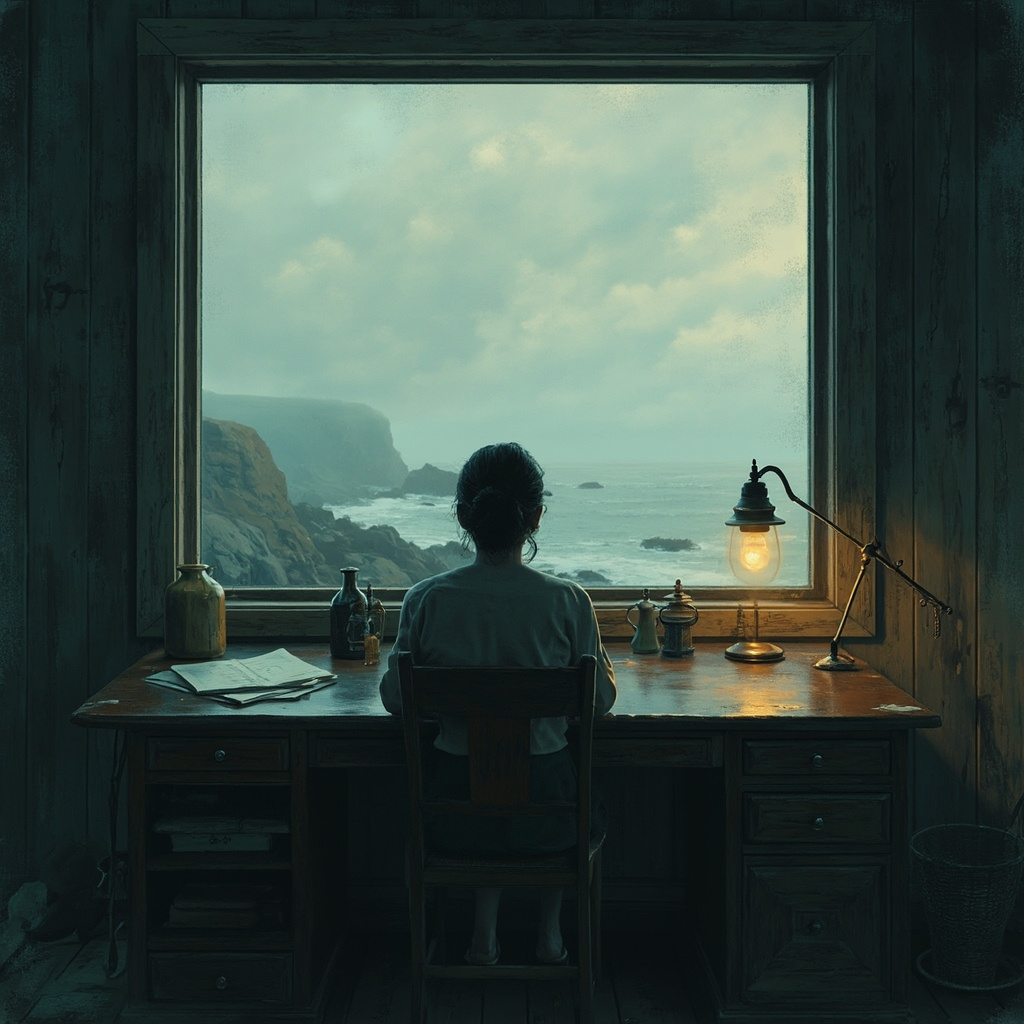
The tide was a meter and a half on the tables, which meant a meter and a quarter at the reef, and the wind had backed to the southwest an hour before the bus arrived. The fog followed the bus down the coast road, patient as a dog. Alma counted the telegraph poles from the window — thirty-one between the last turnoff and the town — and noted that one in four leaned toward the sea, as if pulled by a hand she could not see.
The bus stopped where the road did, at the plaza with the statue of a sailor whose name had been eaten by salt. Alma stepped down with a single suitcase, the leather cracked along the handle where her grandmother's grip had been, or her grandmother's grandmother's. The notary's letter sat in the outside pocket, unopened. She had carried it from Santiago without reading it, the way one carries a prescription one suspects will be unpleasant. The letter could wait. The lighthouse could not.
She counted the steps from the plaza to the base of the hill: one hundred and forty-seven. She counted the windows in the lighthouse keeper's house: nine, though one was boarded with plywood that had already begun to warp. She counted the dead moths on the sill of the front door: eleven, all of them the grey-brown of wet newsprint. The key was under a ceramic tile by the threshold, as the notary had promised. The tile was shaped like a fish. She did not know her grandmother's habits but she recognized the logic: a fisherman's town, a fish-shaped tile. Everything in Punta Bruma had a use, and the use was almost always the sea.
The house smelled of kerosene and old paper. The lighthouse smelled of both, plus brine and something faintly metallic, like a coin held too long in a warm hand. The lens turned overhead with a sound like a clock ticking in another room — steady, patient, indifferent to her arrival. She set her suitcase in the hall. She opened the notary's letter.
The letter was three pages. The first page listed the property: the lighthouse, the keeper's house, the outbuilding that had once been a net-mending shed, and "all contents, movable and immovable, including but not limited to the operational log and its ancillary volumes." The second page listed the conditions: the light must be maintained, the log must be kept, the house must be inhabited. The third page was a single paragraph, handwritten in the notary's careful script. It said: *Your grandmother asked me to tell you that the drawer in the study is locked for a reason. She asked me to tell you to open it anyway.*
[medium pause]
Alma read the letter twice. She folded it into its envelope and placed the envelope on the kitchen table, which was already dusty. She walked through the house: the kitchen, the sitting room with its window facing the harbor, the study with its desk and its single locked drawer, the two bedrooms, the bathroom with its rusted taps. She counted the books on the shelves: forty-six. She counted the tide tables pinned to the wall of the study: seven, one for each year from 1998 to the present. The 1998 table had a corner torn away, as if someone had used it to write a note and never returned.
The drawer was locked. The key was not under the fish-shaped tile. The key was not in the notary's letter. The key was in the top left-hand corner of the desk, in a small ceramic dish that Alma had not noticed until she sat down, because the dish was the same grey-blue as the desk and the light in the study was the color of old milk. The key fit the lock. The drawer opened.
[short pause]
Inside was a ledger.
It was bound in dark leather, the kind that goes soft with age rather than stiff, the kind that remembers the shape of a hand that has held it too long. The pages were cream-colored and faintly ruled, the lines spaced the width of a finger apart, as if the book had been made for a hand larger than Alma's. The first page was blank. The second page was blank. The third page had a single entry, dated 1998, in handwriting that Alma did not recognize:
*March 3rd, high water. Debt incurred: 47,000 pesos. Paid in full by the keeper.*
The entry was signed with a name she could not read — the ink had bled, or the hand had trembled. Beneath it, in the same handwriting, a note: *The sea keeps what the sea is owed.*
Alma turned the pages. There were forty-six entries in all, spanning twenty-six years. The debts were listed in the same format: date, amount, payer. The dates were not calendar dates. They were tide dates — *high water, March 3rd; low water, July 17th; spring tide, November 1st* — as if the ledger operated on a schedule the rest of the world did not share. The amounts varied. The payers varied. The handwriting varied. Some entries were neat, some were hurried, one was written in pencil that had faded to the color of dust.
She reached the last page. The page was dated three days from now.
The handwriting was hers.
[long pause]
She recognized it the way one recognizes a face in a dream — not with certainty, but with a sickening familiarity. The slant of the letters, the way the *a* curled too far to the left, the way the *t* was crossed a fraction too high. She had written like this since she was fourteen, since the year she broke her wrist and the bone healed at an angle the doctor called negligible. She wrote like this. She had written this. She had not written this.
The entry read: *High water, March 14th. Debt incurred: 340,000 pesos. Payable by the keeper to C. Marambio.*
She did not know a Marambio. She did not have 340,000 pesos. She had 22,000 pesos in her bag and a bus ticket back to Santiago in her pocket, though the ticket was for the following week and she had already decided not to use it. She had decided this the moment she stepped off the bus and counted the telegraph poles, though she had not admitted it to herself until now.
She read the entry aloud. Her voice sounded strange in the empty study, too small, as if the room were larger than it appeared.
"High water, March 14th. Debt incurred: three hundred and forty thousand pesos. Payable by the keeper to C. Marambio."
The lighthouse lens turned overhead. The fog pressed against the windows. Somewhere in the harbor, a boat engine coughed and died.
[medium pause]
She turned the page. The margin was narrow, barely the width of a thumb, but someone had written in it. The ink was the color of seawater — that grey-green that is almost black, that shifts in the light like a fish turning. The handwriting was not hers. It was cramped, faint, the letters pressed hard into the paper as if the writer had been rationing space, or ink, or time.
Two words. Maybe three. She held the page closer to the lamp. The ink bled at the edges, the way ink does when it meets salt.
*You are late.*
She set the ledger down. She counted the windows in the study: two. She counted the books on the shelf above the desk: eleven. She counted the seconds between the lens turning overhead: four. She counted the beats of her own heart, which was faster than it should have been, and then she stopped counting, because counting was a thing she did when the world made sense, and the world had stopped making sense at some point in the last five minutes, though she could not say exactly when.
She closed the ledger. She placed it back in the drawer. She locked the drawer and returned the key to the ceramic dish. She walked to the kitchen and made tea with water from the tap, which tasted of iron and salt, and sat at the table with the notary's letter in front of her, as if the letter could explain what the ledger could not.
The letter did not explain.
She drank her tea. She looked out the window at the harbor, where the fog had thickened to the point that the boats were shapes and the shapes were suggestions and the suggestions were the color of the sea.
---
Below, at the harbor bar, a woman sat with a pisco and watched the lighthouse.
Her name was Inés Salazar. She was the town's doctor and its only atheist, and she held her glass by the rim, never the stem, because the stem was where other people's fingers had been and she had spent fifteen years learning what passed between hands. She was watching the lighthouse the way she watched a patient walk into her clinic — noting the posture, the pace, the small signs of distress that the patient would deny.
The new keeper had arrived. Inés had seen the bus, had seen the woman step down with one suitcase, had counted the seconds it took her to look up at the lighthouse before she started walking. Eleven seconds. The last keeper — the keeper before the keeper who had just died, the keeper whose name Inés could never remember — had looked up for three. The keeper before that had not looked up at all.
"Another one," said the bartender, whose name was Roque and who had been pouring drinks in this bar since before Inés was born. He wiped the counter with a cloth that smelled of lemon and old beer. "How long do you give her?"
"Give who?"
"The new one. Up there." Roque nodded toward the lighthouse, which was invisible in the fog, which was always invisible in the fog at this hour. "The last one lasted eleven months. The one before that, fourteen."
"I didn't know there was a betting pool."
"There's always a betting pool. You're a doctor. You should know that."
Inés did not answer. She sipped her pisco. The antiseptic smell of her own hands — she had washed them before coming, as she always did, with the surgical soap she brought from the clinic — mixed with the salt in the air and the lemon on the counter and the distant, mechanical click of the lighthouse lens turning overhead.
"She'll be fine," Roque said, though his tone suggested he did not believe it, or did not care, or both. "They're always fine at first."
Inés set down her glass. She looked at the harbor, where the boats were tied and the fog was thick and the water was the color of the ink in the ledger she had never seen.
"She'll be fine," Roque said again, and poured her another pisco, and the fog came in, and the tide turned, and the lighthouse kept its light.
The first entry has been made. The ledger is open.
What shipped this cycle is the thing you are holding: a story told in installments, a mystery that accrues like interest, a coastal town whose accounts are kept by a book that writes ahead of its readers. You are holding Episode 1. It is the inheritance — the moment the keeper arrives and finds the drawer unlocked, the moment the impossible is reported in the tone of a weather report, the moment the first debt is named.
What you will experience, as you read, is the pace of a tide coming in. Each episode advances one ledger entry. The dread accumulates. The fog thickens. The handwriting in the margins grows clearer, and the debts grow larger, and the town of Punta Bruma begins to remember what it has been trying to forget since 1987. You will meet the doctor who does not believe. You will meet the fisherman who writes from the other side of the tide. You will meet the sea, which keeps its accounts.
This is the first page. There are seven more. The light is on. The lens is turning. The drawer is open.
The tide was a meter and a half on the tables, and the fog held the town like a hand holds a coin, and the lighthouse kept its light, and the ledger kept its place, and somewhere in the margins, in ink the color of seawater, a dead man counted what he owed, and wrote it down.
Next time
*Story hook:* Alma returns to the ledger the next morning and finds a second entry — this one in handwriting she does not recognize. The debt is owed to Elías Fuentes, a fisherman the town insists has been dead since 1987. The amount is exact. The date is today. *Product hook:* Inés, who has been watching from the harbor, finally introduces herself. She asks Alma if she has noticed the smell of salt coming from the pages.
Comments
0Sign in to leave a comment.
No comments yet. Be the first to share your thoughts.
Chronicle