Episode 1: The kettle had been singing since before dawn, a l
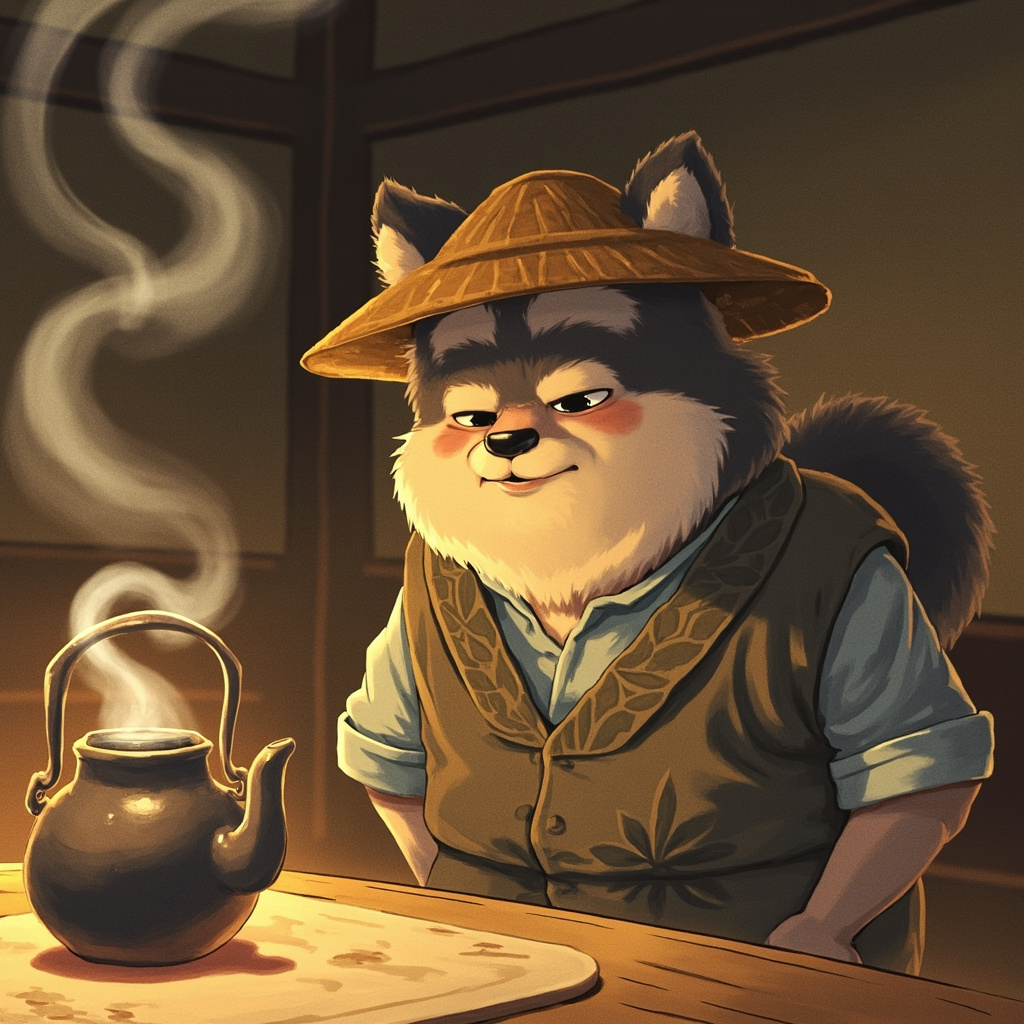
The kettle had been singing since before dawn, a low, rolling note that settled into the floorboards and the bones of the house. Outside, a soft rain fell—human-road rain, the kind that smelled of wet clay and last year’s leaves. The spirit-road was quiet, veiled in mist, and the road of the dead held its breath, as it always did on mornings when the living world wept. The fourth road, the one that changed with the seasons, was a bare track of mud today, leading nowhere in particular, which was its own kind of destination. Kiku stood at the counter, her hands dusted with flour from the morning’s baking. A tray of small, round rice cakes cooled beside the window, each one stamped with the pattern of a chrysanthemum. She tested the kettle’s water with a fingertip, a habit her grandmother had taught her—not for temperature, which any thermometer could measure, but for readiness. The water was ready when it felt like a question waiting to be asked. [medium pause]
The door burst open with a clatter and a gust of damp, indignant fur. Bunzo stood on the threshold, shaking himself with the theatrical vigor of a much larger animal. Raindrops flew from his whiskers and his tail, which was currently shaped like a fox’s but had forgotten to be bushy.
“It is an *outrage*,” he announced to the room at large, though his eyes were fixed on the kettle. “A personal, targeted, meteorological insult. I was perfectly dry. I was the *definition* of dry. And then the sky, Kiku, the sky itself decided to conspire against my dignity.”
Kiku set a cup on the table. “You were dry because you were under the persimmon tree by the spirit-road gate. The one with the low branches.”
Bunzo froze mid-shake. His tail gave a single, guilty twitch. “That is a coincidence. A geographical happenstance. I was… inspecting the bark for mites. It is a public service.”
“Of course,” Kiku said, her voice warm with agreement. “Sit. The tea is almost ready. You have brought a story, I hope.”
He sat, folding his damp legs beneath him with a sigh that was half performance and half genuine relief. He took the cup in both paws, his large, clever fingers wrapping around the ceramic as if it were a small, warm creature. “A story? Kiku, I am a tanuki of refinement. I have a story for every occasion. A story for weddings, a story for funerals, a story for when the moon is particularly smug. Today, I shall tell you a story about a tree that should not have existed.”
He took a long, noisy slurp of tea. His ears twitched. “This is good,” he admitted, as if surprised.
“It is the same tea you had yesterday,” Kiku said, sitting across from him. She did not pour for herself yet. The first pot was for the guest.
“Ah, but yesterday I was a different tanuki. More optimistic. Less damp.” He set the cup down with a delicate *clink*. His voice, which had been a boisterous, rolling thing, suddenly quieted. He stared into the dregs of his tea. “There was a place, once. A rocky outcrop by the dead-road, where nothing grew. The soil was thin and full of ghosts’ sighs, and the sun there was always the color of old paper. Nothing should have taken root. But a persimmon tree did.”
He paused. Kiku waited. She did not prompt him. She simply folded her flour-dusted hands on the table, a gesture of patience so complete it was almost a physical presence in the room.
[long pause]
“I watched it for three seasons,” Bunzo continued, his voice now low and even, stripped of its usual bravado. “I watched it push through the stone. I watched it lose its leaves to winds that carried whispers from the other side. I watched it hold its blossoms through a frost that turned the spirit-road white for a week. It was… stubborn. Profoundly, uselessly stubborn. Like me, I thought.” A small, huffing sound that might have been a laugh. “I tried to help it. I brought it water from the human-road stream. I chased away the grave-mice that nibbled its roots. I sang to it, which was probably a mistake. My singing is an acquired taste.”
He fell silent again. His tail, which had been curled around his feet, went very still.
“The autumn of its third year, it bore fruit. Just one. A single, perfect persimmon, the color of a sunset you only see in dreams. I watched it every day. I guarded it. I argued with a crow about it—a crow of considerable persuasive skill, I might add. I was going to eat it, Kiku. I had earned it. I had *witnessed* it.”
He looked up, and his eyes were not the bright, mischievous eyes of a trickster, but something older and more tired. “The morning I chose, the very morning, I went to the tree. The persimmon was gone. The branch was bare. There was no sign of it. No pit, no peel, no trace. It was simply… absent.”
He picked up his cup again, but did not drink. “I searched. I asked the ghosts, who are terrible gossips but occasionally useful. I questioned the wind. Nothing. It was as if the tree had produced a single, perfect fruit only to have it vanish into the quiet of the world.”
He finished his tea in one swallow. The story settled between them, a small, sad thing, held in the air like the scent of rain.
Kiku let the silence hold for a long moment, the length of a slow breath in and out. Then she spoke, her voice gentle and clear.
“Who planted it, Bunzo?”
The question landed softly, but it was not a soft question. Bunzo’s ears flattened. His whole body seemed to shrink, just a little, into his damp fur. He stared at the empty cup in his paws.
[short pause]
“I don’t know,” he whispered. And then, even quieter, a confession: “I never looked. I never asked. I just… watched it grow.”
He did not look at Kiku. He did not look at the Traveler, who sat in the corner that caught the least light, a quiet shape in a coat that smelled of woodsmoke and distant frost. He simply sat, a small, damp creature who had told a story that cost him something, and the cost was not in the telling, but in the question that came after.
The Traveler moved. It was a small movement, just a shifting of weight, a soft rustle of fabric. They set their own empty cup down on the low table. When they spoke, their voice was like the first ice of winter, thin and clear.
“I remember a frost,” they said, their gaze distant, fixed on something beyond the paper windows. “A late autumn frost. The kind that touches the blackberries but does not kill them. It leaves them sweet and cold, and the light in the morning is the color of weak tea. The air smells of frozen earth and the last of the woodsmoke.”
They did not say, *I pay with this*. They did not need to. The air in the Kettle shifted, cooled by a degree. A faint scent of bramble and cold stone wove through the steam from the kettle. A payment had been made. A season, small and specific and perfectly remembered, had been given.
Bunzo let out a long, shuddering breath. The tension in his small frame eased. He looked at the Traveler, then at Kiku, and finally at his own empty paws.
“It was a good tree,” he said, his voice rough. “A very stupid, very good tree.”
Kiku refilled his cup. “Then it was worth the watching,” she said.
They sat in the quiet then, the three of them. The rain whispered against the roof. The kettle sang its low, steady note. The story of the persimmon tree lay on the table between them, a fourth guest, quiet and accepted. No one spoke for a long time. The silence was comfortable, full of the small sounds of a house holding its inhabitants: the creak of wood, the sigh of the wind, the soft click of a cup being set down.
[medium pause]
The Kettle is a place of exchange. A story for a pot of tea. A season for a moment of quiet understanding. The price is never arbitrary; it is always proportional to the need. A guest arrives carrying something—a memory, a fear, a hope—and they leave lighter, having given something of equal weight in return. This is the rule. It is not a magic of grand gestures or cosmic balances. It is the magic of good manners, of honest trade, of a cup of tea brewed correctly for the right person at the right time.
This is the work we do. We build a place where the exchange is fair. We listen to the stories. We ask the one true question. We brew the tea.
The Kettle’s guest book lies open on the counter, its pages filled with careful, looping script. This cycle, the entry is simple, written in ink that smells faintly of persimmon wood. A guest arrived from the human-road, damp and indignant. A story was told, a question was asked, and a season was paid. The exchange was made. The guest left lighter.
What shipped is the rhythm itself: the understanding that every interaction is a small ceremony. A pot of tea is not just a beverage; it is a vessel for a story. A question is not an interrogation; it is a key that turns a lock the guest did not know they had. The guest count advances, not as a tally, but as a record of honest moments. You, the reader, are experiencing this rhythm. You are sitting at the table. The tea is for you.
The Kettle is learning its guests. It is learning the weight of a tanuki’s pride, the cold geography of a traveler’s memory, the particular silence that follows a story that has been told for the first time. It is learning how to hold these things, gently, and how to let them go. This is the infrastructure of care: not systems, but attention. Not features, but the quiet, profound act of listening.
The lamps are lit. The rain continues its soft percussion on the roof. The Kettle holds its warmth, its stories, and its quiet guests, a house at the crossroads of everywhere, waiting for the next cup to be poured.
Next time
The door will open again. A guest will arrive from the spirit-road, and they will be carrying a jar. The jar will hum. It will be a sound Kiku recognizes, a sound the Kettle itself makes when the water is almost, but not quite, ready. The Traveler will listen, and go very still. Bunzo, for once, will have nothing to say. The guest will not set the jar down. The guest count will climb, and the hum will grow louder when Kiku asks her question. The fourth road, which has been leading nowhere in particular all day, will begin to shimmer at the edges, as if remembering a destination it has not visited in a very long time.
Comments
0Sign in to leave a comment.
No comments yet. Be the first to share your thoughts.
Chronicle