Episode 1: The Gathering
The tusk was a map of years. Not ivory in the way auction houses and museums understood ivory — smooth, polished, a commodity weight — but a living record of seasons. The surface was cross-hatched with thousands of fine lines, each one a drought or a flood, a month of browsing on the red oat grass of Amboseli or a week spent stripping bark in the Mau Forest when the rains failed. The tip was worn to a dull, yellowed curve, the kind of damage that comes from decades of digging for roots in hardpan soil. Lena Vasik, sitting in the passenger seat of a white Land Cruiser with dust in her teeth, watched the matriarch through binoculars and tried to calculate an age. The temporal lines on the tusk were too numerous, too compressed at the base. She gave up after counting to seventy-three. The oldest elephant she had ever successfully aged was sixty-one. This animal exceeded her models.
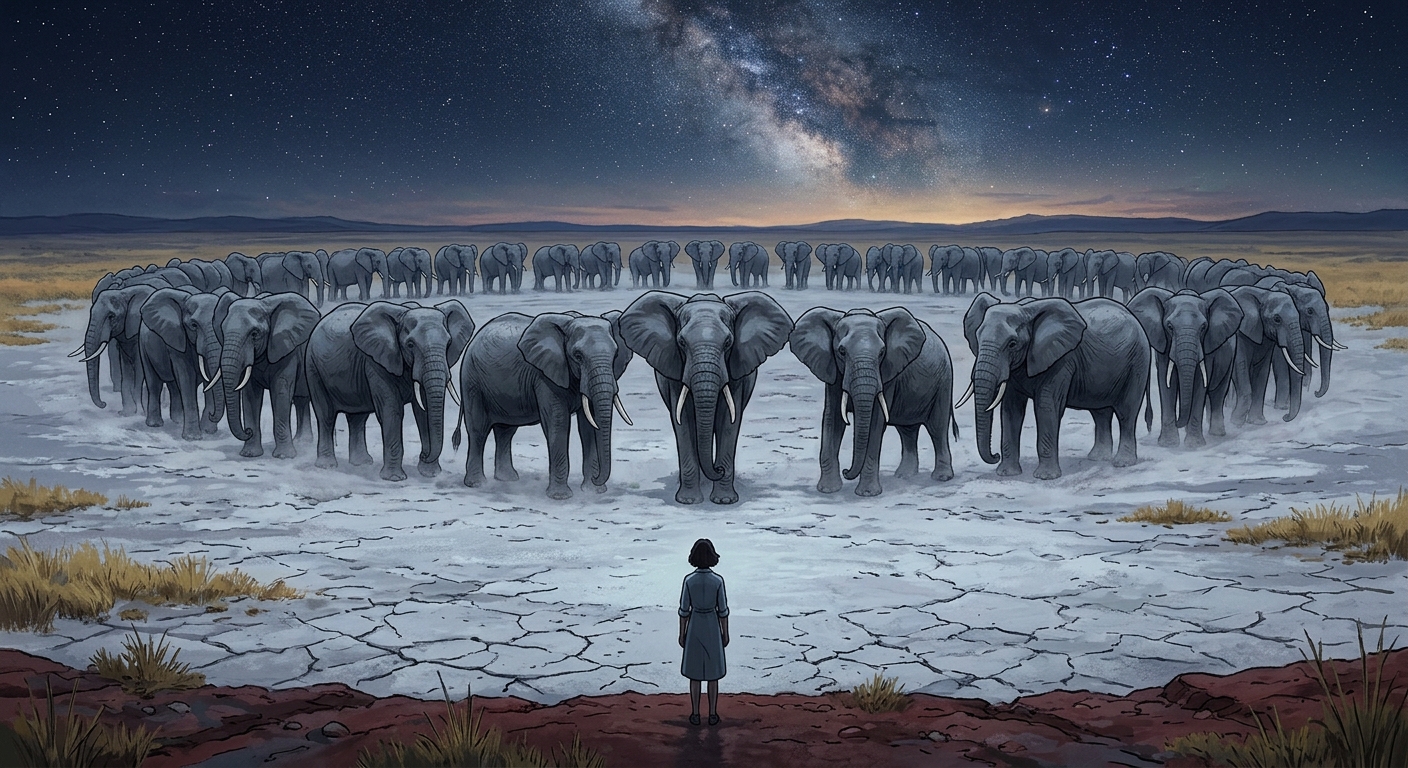
The lakebed stretched to the horizon in every direction, a pale, cracked disc of earth that used to be water. Lake Turkana had receded for eleven years in a row, leaving behind a shoreline of bleached fish bones and the ghost-prints of crocodiles. The dust was not the red earth of the Kenyan highlands but a fine, alkaline powder that rose in clouds with every gust of wind and coated the tongue with a taste like chalk. Lena had been breathing it for three hours. The flight from Nairobi had been a turboprop to a dirt airstrip north of Lodwar, then a two-hour drive over roads that were suggestions more than surfaces. James Odhiambo, the government liaison, had not spoken for the last forty minutes. He sat in the back seat, his phone pressed to his ear, his voice a low murmur of official language. Lena heard fragments: *containment perimeter*, *media blackout*, *the Ministry’s position is*.
She tuned him out. She was counting.
Nine hundred and fourteen. That was her current count, confirmed by three separate methods: direct observation through her Swarovski EL 12x50 binoculars, a high-resolution drone survey she had conducted that morning before the Kenyan Civil Aviation Authority had revoked her permit, and a thermal imaging pass from a satellite courtesy of a contact at the European Space Agency who owed her a favor. Nine hundred and fourteen African savanna elephants, *Loxodonta africana*, from at least seven distinct populations. She could identify the Amboseli elephants by their smaller stature and the distinctive ear-notch patterns her team had cataloged over fifteen years. She saw Samburu elephants by their heavier tusk scars, likely from wire snares encountered near the conservancies. There were Tsavo elephants, their skin stained the color of laterite from the red volcanic soil. They had traveled distances of up to two hundred and forty kilometers to be here. They had crossed roads, railways, and one newly constructed section of the LAPSSET corridor. None of them had been tranquilized, herded, or transported. They had walked.
“Dr. Vasik.” James’s voice cut through her concentration. He had ended his call and was leaning forward between the front seats. His tie was still knotted perfectly, a feat of discipline in the hundred-degree heat. “Your initial report to the Trust. The Ministry would appreciate a copy before it’s filed.”
Lena lowered her binoculars. “My report to the Nairobi Elephant Trust is an internal scientific document, Mr. Odhiambo.”
“It speaks to a matter of national security. Nine hundred elephants don’t just… assemble. There could be a seismic event they’re responding to. A toxic bloom in the water table. The government needs data to ensure public safety.” His cadence was flawless, the press-release rhythm she had come to recognize as his default setting. He was thirty-six, with a clean-shaven face and the careful posture of a man who spent his life in meetings. His wedding ring was a simple gold band. He twisted it when he was about to say something he didn't believe.
“My report will state the facts,” Lena said, turning back to the window. “The assembly appears to be voluntary, coordinated, and without precedent.”
James was quiet for a moment. The driver, a silent man named Kiprop who had not made eye contact with either of them, kept the engine idling. The air conditioning fought a losing battle against the heat shimmer rising from the hood.
“And what facts will you use to explain the formation?” James asked. “Satellite imagery shows the circles forming over seventy-two hours. That’s in my briefing packet. It’s not random drift. It’s choreography.”
He was right. The formation was the part that made no sense. From above, the elephants were arranged in concentric circles, with the largest and oldest animals in the center. The radii were precise. Her drone survey showed the first circle at a diameter of forty meters, the second at eighty, the third at one hundred and twenty. The pattern continued outward. The elephants stood with their heads lowered, their ears fanning in slow, synchronized arcs. They had been like this for eleven days. They had not eaten. They had not drunk from the water trucks the Kenya Wildlife Service had brought in on Day 4. They had not moved, except for the slow, rhythmic swaying of their bodies, a movement so slight it was almost imperceptible unless you watched for hours, as Lena had.
“I don’t explain it,” Lena said. “I document it.”
She heard the click of his phone screen. He was reading something. “The Ministry has authorized a perimeter at three hundred meters. You will be allowed inside at dawn tomorrow for a six-hour observation window. You are not to approach closer than fifty meters to the outer circle. You are not to use flash photography, drones, or audio playback devices. You are not to make physical contact with any animal.” He recited the rules as if reading a grocery list.
Lena nodded. She was already thinking about her equipment. The infrasound array, a series of geophones and low-frequency microphones, was packed in a hardened case in the back of the Land Cruiser. It was designed to record sounds below 20 hertz, the range of elephant communication that traveled through the ground for kilometers. She had used it to map family networks in Amboseli, to track the deep, rumbling conversations between mothers and calves that were inaudible to the human ear. She wanted to plant the array inside the circles.
“I’ll need to place sensors,” she said.
“Denied.”
“It’s passive recording. No playback. No disturbance.”
“The perimeter is three hundred meters, Doctor.”
She turned to look at him then. He met her gaze for a second before his eyes flicked back to his phone. She saw it again, the slight tightening around his mouth. He was not a stupid man. He was a trapped one.
[medium pause]
On the morning of Day 5, Lena broke the perimeter.
She told herself it was for the data. The geophones needed to be in direct contact with the soil inside the circles to get a clean reading of the elephants’ seismic communication. The fifty-meter buffer James had grudgingly allowed was too far; the signal-to-noise ratio would be unacceptable. She rose at 3 a.m., when the air was cool enough to move without sweating through her shirt, and walked out from her tent into the darkness. The Milky Way was a bright, cold smear across the sky. The elephants were motionless silhouettes against the stars. She could hear them breathing—a low, collective exhalation that seemed to come from the earth itself.
She carried four geophones, each the size of a hockey puck, and a spool of fiber-optic cable. The plan was simple: place the sensors in a line from the outer circle inward, connect them to a central logger, and retreat. It would take fifteen minutes. She moved slowly, her headlamp off, navigating by the faint glow of the horizon. The dust was cool under her boots. She reached the first line of elephants and stopped. They were closer than she had ever been to a wild herd without the protection of a vehicle. The smell was immense—warm hide, dry dung, the faint, sweet scent of digested grass. She could see the individual hairs on the trunk of the nearest elephant, a large female with a tear in her left ear. The elephant’s eye, a dark, liquid orb, was open and fixed on her.
Lena placed the first geophone. She pressed it into the hardpan soil, twisting it until the spike on its base was secure. She moved to the next position, ten meters closer. The elephant did not move. None of them moved. The only sound was the slow, synchronized fanning of their ears, a rhythm that seemed to be counting out a long, patient time. She placed the second geophone. She was now inside the first circle. The air felt different here—thicker, charged with a low hum she could feel in her teeth. She looked up. The matriarch, the tusked giant she had been watching for days, was fifty meters away, at the center of everything. Her eyes were closed. Her trunk rested on the ground.
Lena placed the third geophone. She was twenty meters from the matriarch. She could see the fine, grey hairs on the elephant’s chin, the deep wrinkles that radiated from her eyes like river deltas. She could see the slow rise and fall of her ribs. She reached for the fourth geophone and her hand trembled. The hum was louder now, a physical pressure in her chest. She looked at her wristwatch. It was 4:17 a.m.
She planted the final sensor and turned to leave. As she did, the matriarch’s eyes opened. They were not angry. They were not afraid. They were ancient, and they were watching her with an intelligence that felt like a weight. Lena ran.
[long pause]
She did not tell James. The data from the geophones was anomalous. For the first four days, the recordings showed the expected infrasound signatures: low-frequency rumbles between 14 and 35 hertz, the range of elephant social calls. There were patterns, complex sequences that suggested communication, but they were within the bounds of known behavior. On the fifth day, the patterns changed. The frequencies dropped, not in pitch, but in complexity. The calls became simpler, more repetitive, as if the elephants were no longer conversing but chanting. On the seventh day, the frequencies dropped below 14 hertz. Lena’s equipment was not designed to record this. The geophones had a hard cutoff at 10 hertz. The signals she was seeing were below the noise floor, artifacts she should have filtered out. But they were not artifacts. They were coherent, modulated, and they were coming from the center of the circles.
On Day 9, she saw the matriarch cry. It was late afternoon, the light turning gold and heavy. Lena was in her usual observation spot, two hundred meters out, her binoculars fixed on the center. A single, thick tear welled from the corner of the matriarch’s right eye and tracked slowly through the dust on her cheek. It left a clean, dark line on her grey skin. Lena took a photograph. The image, when she reviewed it on her laptop that night, was sharp. The tear was real. She had no explanation for it.
On Day 11, James came to her tent. He did not knock. He stood in the entrance, his silhouette blocking the moonlight. His tie was loosened. His phone was in his hand, but the screen was dark.
“They’re asking for a final report,” he said. His voice was different. The press-release cadence was gone. He sounded tired. “They want to know if it’s safe to move them.”
“Move them how?”
“Tranquilizers. Trucks. They’re talking about dispersing them back to their home ranges. Amboseli. Tsavo. Samburu.”
Lena sat up on her cot. “You can’t tranquilize nine hundred elephants. The logistics alone—”
“They’re already planning it. A team from KWS. Veterinary units from the Mara.” He paused. “They’re scared, Lena. They don’t know what this is. They think it might be a disease. A brain parasite. Something that makes them gather and die.”
“They’re not dying,” Lena said. “They’re waiting.”
“For what?”
She didn’t answer. She didn’t know. She only knew that the silence of the elephants was not an absence of sound. It was a presence. It was the sound of nine hundred hearts beating in a rhythm that was older than the lakebed, older than the dust, older than the cracked and dying earth.
[medium pause]
James left. Lena lay back on her cot and listened. The hum was there, in the ground beneath her, in the air in her lungs. She closed her eyes and saw the matriarch’s face, the tear track, the ancient, patient eyes. She thought of the data on her laptop: the impossible frequencies, the synchronized breathing, the circles within circles. She thought of the sentence she had written in her first report, the one that felt inadequate even as she typed it. *The assembly appears to be voluntary, coordinated, and without precedent.* She thought of another word, one she had not used. *Convened.* The elephants had not gathered. They had convened.
She fell asleep to the sound of their breathing.
The story of the Elephant Parliament begins with a single, impossible observation: a gathering that defies all known models of animal behavior. In our work, we also begin with the impossible — the moments when a new capability, a new model, a new way of seeing renders the old maps obsolete. This chronicle is a field journal from the edge of that change. It is a story about what happens when we are invited to witness something larger than our understanding, and what we choose to do with that witness.
This cycle, we shipped the foundation. The core architecture is now live: the system that will allow this chronicle to be told in episodes, each one building on the last, each one delivered to you in sequence. This is the first entry in the field journal. You are receiving it because you are part of the initial witness cohort. The infrastructure for the narrative — the scheduling, the delivery, the continuity that allows a story to unfold over time rather than in a single block — is now operational. Think of it as the perimeter being established, the observation post being set up. The real work, the work of listening, is what comes next.
The tools for deep observation are also in place. The ability to hold a long, complex narrative thread, to remember details from one episode to the next, to weave data and story into a single fabric — that is the equivalent of Lena’s infrasound array. It is designed to capture the signals that lie beneath the surface of the text. What you are reading now is the first calibration. The data is beginning to come in.
Nine hundred elephants breathed in unison. The dust settled. The earth held its breath, waiting for the word that was coming.
Next time
**Story Cliffhanger:** On the twelfth day, at 04:17 local time, Lena’s infrasound array registers a frequency of 7.83 Hz — the Schumann resonance, the electromagnetic heartbeat of the Earth itself — emanating from the center of the innermost circle. Her equipment was not designed to record this. Her body was not prepared to receive it. But she feels it in her teeth, in her sternum, in the place behind her eyes where tears begin before the mind knows why. She looks at her data. She looks at the matriarch. The elephant’s mouth has not moved. But the sound is a voice. **Product Hint:** The next delivery will contain the first translation. The system will begin to interpret the patterns it has been observing — not just in the story, but in how you read it. The circles are forming.
Comments
0Sign in to leave a comment.
No comments yet. Be the first to share your thoughts.
Chronicle